
Notes:
The Intersection of Economics and Politics
Since you are approximately three-quarters of the way through SociologicalYOU, you know that most of our social behaviors result from socialization and specific social factors. Socioeconomic status (SES) predetermines many of our “choices” in life. The word “choices” is in quotation marks because, although we have the freedom to make our own decisions about how we conduct our social lives, many of our decisions are heavily influenced by our personal and family income, educational attainment, occupational status, and geography. In addition to SES, political involvement predictors include your participation in voluntary organizations in high school and your social media habits. You could predict each of your classmates’ level of political engagement, to some degree of accuracy, by determining SES, involvement in school clubs and organizations, and social media habits.
There are three basic categories of political involvement: political participation, civic participation, and political consumerism. The first category, political participation, actions to support the government or politicians (HP), includes voting, wearing a badge to support a candidate, and being a member of a political party. If you have exercised your right to vote, you have engaged in political participation (C-19). Have you involved yourself in the Young Democrats, Young Republicans, or other campus political organizations? How has your socialization process contributed to your involvement or lack of involvement? If you engage in civic participation, individual and collective action to address issues of public concern, this is a more specific and targeted involvement that includes donating to a candidate, volunteering to collect signatures, and engaging in rallies and protests. Charles Koch and, before his death, his brother David have been actively engaged in civic participation. They have donated to candidates to address their personal concerns, which they believe are also important public concerns. A third category is political consumerism, choosing producers and products with the goal of changing ethical or objectionable institutional or market practices, which is when you boycott or “buycott” a product based on moral and ethical reasons. Consumers can practice citizenship and become important political actors by pressuring corporations to change their business practices. You may have chosen not to purchase items from clothing and footwear companies due to their use of child labor in other countries or refused to gas up your automobile at specific gas stations due to environmental practices and disasters and human rights policies of the multinational petroleum corporations.
The Civic Voluntarism Model
Who is most likely to be politically engaged? Using the sociological perspective, you can analyze why individuals and groups get involved in politics. Economics, specifically SES, is one of the strongest predictors of whether individuals are involved in politics. Children who grow up in upper-middle-class and upper-class families are more likely to have politically engaged parents. Verba, Schlozman, and Burns (2005) characterize these parents as more likely to
- have high levels of political knowledge, interest, efficacy, and tolerance
- engage in political discussion
- be politically active
- encourage their children to become independent and to express themselves fully in family discussions
The children of these parents are having political discussions in the home and have the means to pursue higher education, which also presents opportunities to engage in political conversations. The Civic Voluntarism model (HP) supports that SES is a strong indicator (Verba, Schlozman, and Brady 1995). This model indicates that individuals civically volunteer based on three factors: resources, motivation, and location within recruitment networks. In other words, those who are able to, want to, and are asked to take part are more likely to be politically involved. Each of these factors is more conducive to upper-income families. Did your family have the economic means to participate by donating to political campaigns, taking time off work to participate in political rallies, or purchasing alternative products or services as a means of protest? Were you exposed to high levels of political discussion in your home? Were important political issues and current events discussed around the dinner table? Were you directly or indirectly taught how politics relate to your everyday life? These family behaviors all increase political engagement (Huckfeldt and Sprague 1995). The process continues through higher education as students gain civic skills by participating in non-political organizations and developing social networks. By being in college, you have situated yourself within a social environment that will provide opportunities for being recruited to participate in political activities and organizations.
In addition to SES, your participation in voluntary organizations as a teenager is a strong predictor of your future participation. Ellen Quintelier, a Belgian sociologist, asked, “Who is more politically active: the athlete, the scout member, or the environmental activist?” The answer is the environmental activist, as individuals who participate in sports groups are more homogenous and have more in-group goals. A teenager interested in environmentalism is more individualistic and focused on out-group goals (Quintelier 2008).
The Scouts of America (formerly Boy Scouts of America or BSA) are homogenous and more outwardly focused than athletes but less so than environmentalists. Individuals with a higher SES have more resources to focus on out-groups than those with fewer resources, thus a greater likelihood of political participation. Quintelier’s study also found the more voluntary organizations a student joins in high school, the more predictive of increased political participation in adulthood. This is most likely due to gaining more civic skills and resources, which fits the Civic Voluntarism Model. Once in college, students involved in political activism continue their participation throughout their lifetime. Fendrich and Lavoy (1988) conducted a longitudinal study beginning in the 1960s and followed college students engaged in political activism. Over 25 years later, most of these students were still politically engaged. The profile of politically engaged individuals is depicted

Political Participation and Social Media
The last component of the political engagement profile is related to social media. Research shows that more Americans are using social media to engage in civic and political participation (Jones 2019; Yang and DeHart 2016; Wang 2013; Rainie et al. 2012). Engagement in social media provides an easily accessible means for users to connect with politicians, stay up to date with the latest political news, and support political platforms and current issues. Have you used social media for any of these purposes? The downside to social media is the potential to fall prey to fake news, conspiracy theories, and confirmation bias. Those more connected to social media are also more politically engaged, but we can’t definitively say there is a correlation between the two and state that social media causes political engagement.
The younger generations are more likely to get their news from social media, which is more diverse than news gathered by the older generations from legacy media (i.e., local, national, and cable television). Viewers of legacy media are more likely to choose a television source providing news from primarily one political party. Social media allows younger voters to be exposed to various political sources resulting in the decentralization of information and exposure to a greater diversity of opinions compared to older cohorts relying primarily on legacy media. Although, the ability to choose hyper-personalized social media news feeds can result in participating in an echo chamber, thus limiting exposure to a wide array of opinions. Therefore, how individuals curate political information via media will likely impact their political views and engagement (Foster and Markiewicz 2023). Even though access to the internet and social media is relatively available to all SES levels, there is still a significant socioeconomic distinction regarding education and income. Americans with bachelor’s and graduate degrees and higher household incomes are more likely to be politically engaged online and offline. The gap between lower and higher SES is significantly wider in the following areas:
- attending a political rally or speech
- working or volunteering for a political party or candidate
- contacting an official about an issue that is important to you, either offline or online
- donating to a political candidate
Have you engaged in any of these four activities? The most important question is why you have or have not been politically active. One answer is, “I am just not interested in politics.” Another response might be, “My vote or contributions will not matter.” Both statements may have some truth, but when you apply the sociological perspective, your family’s socioeconomic status has influenced your attitudes about political engagement. If your family did not discuss politics and you did not observe your parents attending a political rally or volunteering for a political candidate, then you are more likely to say, “I am not interested in politics.” This is an example of how sociology can provide insight into your beliefs and whether you engage in political activities.
A survey by the Pew Research Internet Project revealed that 39 percent of adults in America used social media in the 2012 elections to engage in one of these eight categories:
- 38 percent used social media to “like” or promote political content others posted
- 35 percent used social media to encourage others to vote
- 34 percent used social media to post comments on political issues
- 33 percent used social media to repost political content
- 31 percent used social media to engage in political activities
- 28 percent used social media to post links to political content for others to read
- 20 percent used social media to follow political candidates
(Rainie et al. 2012)
Although these seven categories indicate political participation based on the Pew study, it can be argued that social media facilitates political expression more than participation (Zuniga, Molyneux, and Zheng 2014). Take a moment to reread the seven categories and determine how many appear more expressive than participatory. Most of the categories pertain to consuming or redistributing information rather than directly supporting politicians. The Pew study found that only 18 percent of the respondents engaged in some political activity after reading about it online. Next, we will turn our attention to women and politics.
Women and Politics
There are fewer women than men in politics. The reasons behind the lopsided numbers are discoverable by using the sociological perspective. You arrived at your current level of political engagement due to social factors such as SES and some of your aptitudes and interests in politics. In much the same way, socialization patterns are impacting young women’s political ambitions.
Ilhan Omar (see photo) has been the U.S. Representative for Minnesota’s 5th Congressional District since 2019. She was outspoken as a freshman Congresswoman and was denied an official visit to Israel in August 2019 due to previously calling for and working to impose boycotts on Israel. What do you think her political socialization patterns were that encouraged her to seek office? Why are there significantly fewer women in Congress and the highest cabinet positions?
Political Socialization
Political socialization begins in the family and continues through school and into the workforce. Are boys and girls treated the same regarding political ambitions within the family? Lawless and Fox (2013) identify five factors that hinder young women’s political ambition. The first three obstacles result from a combination of family, peers, school, and media, all of which are agents of socialization:
- Young men are more likely to be socialized than young women to pursue a career in politics.
- Young women are exposed to less political information at school, among peers, and within the media.
- Young men are more likely to play sports, which develops a competitive nature and desire to win.
These agents of socialization view political ambition more favorably among boys and have a powerful impact on whether a girl daydreams about becoming a politician. If girls express interest in pursuing a political career, there may be pushback from parents, friends, and teachers.
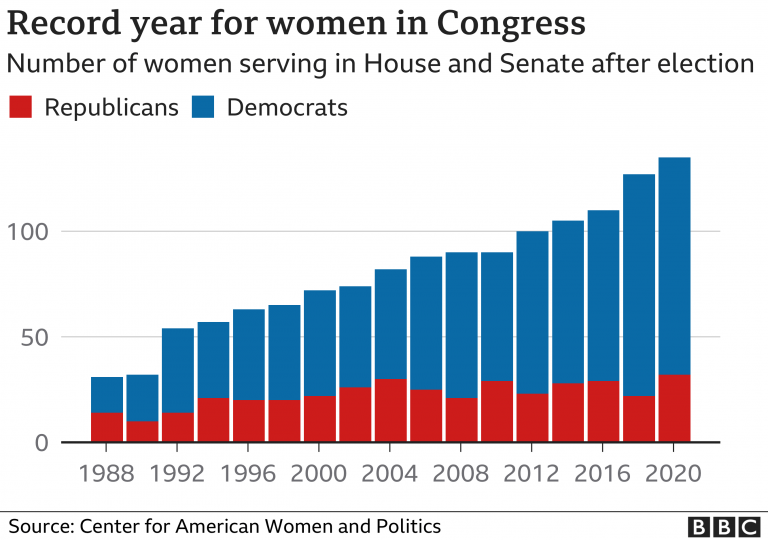
In 2022, 27.1 percent of the U.S. Congress were women (Center for American Women and Politics 2022). The U.S. ranks 70th out of 187 countries regarding the number of women in national parliaments (Inter-Parliamentary Union 2022).
The last two hindrances pertain to how women are encouraged to run or not to run for public office once they are older:
- Young women are less likely to receive encouragement from anyone to run for public office.
- Young women think they are less qualified to run for public office even when established in their careers.
This may help explain why women hold only a quarter of the seats in Congress. Figure 11.1.2 describes the representation of women in the 117th Congress. Notice there were significantly more Democratic than Republican Congresswomen.
Each year Rwanda celebrates its Liberation Day on July 4. This marks the end of the genocide that killed more than 800,000 people in 1994 and the beginning of a new government on July 4 of the same year. One aspect of the new constitution is that 30 percent of political and government candidates must be women (Dudman 2014). Worldwide, women only represent 26 percent of the seats in parliaments (Table 11.1.1). Before the Rwandan civil war and genocide, few women were in politics. Over the past two decades, there has been a sweeping cultural shift in Rwanda’s gender roles. This social change is largely attributed to Swanee Hunt, a former Harvard professor, philanthropist, and activist for women’s inclusion in governments (1972 TCU alumnus). After the 1994 genocide in Rwanda, she developed programs to involve women in politics and government. These programs provided opportunities for women to participate in parliament resulting in empowerment, equality, and justice for Rwandan women (UN Women Staff 2018). Rwanda has the most women in parliament (61 percent) compared to 27 percent in the U.S., which puts the U.S. in the 87th position among 192 countries (Inter-Parliamentary Union 2022). This can be partly explained by how the socialization process occurs in different countries worldwide.
| Region | Percent of Women in Parliament May 1, 2022 |
|---|---|
| The Middle East and North Africa | 16.5% |
| Pacific | 20.9% |
| Asia | 20.7% |
| Sub-Sarahan Africa | 26.0% |
| Europe | 31.1% |
| The Americas | 34.6% |
| World Average | 26.0% |
Economics, Politics, and Climate Change
This section will apply the sociological perspective to the link between politics and climate change. The topic of climate change (HP) has been debated for decades. On one side, individuals and groups claim that humans cause rising temperatures and erratic weather patterns; on the other side, they believe climate change revolves around the naturally occurring cycles of rising and lowering temperatures over tens of thousands of years. Our goal is not to convince you to choose a side but to apply the sociological perspective to the topic in relation to economics and politics. Remember that attempting to remain neutral and unbiased is crucial when practicing sociology. Figure 11.1.3 shows the opinion of Americans on the cause of global warming between 2008 and 2018. As an update, the percentages (not reflected in the figure below) have changed from 62 to 61 percent and from 23 to 28 in 2023 (Ipsos 2023). The daily news reflects record-breaking weather events and disruptions in the lives of people around the world, but yet the percentage of Americans who think global warming is mostly caused by natural changes in the environment has only slightly decreased since 2008. Why do you think 28 percent of Americans do not think global warming is caused mostly by human activities?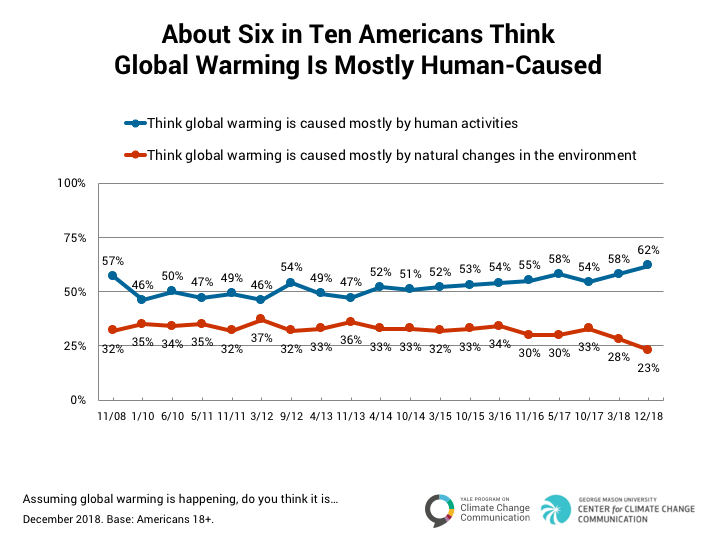
A discussion of climate change must begin with Al Gore’s 2006 documentary film, An Inconvenient Truth, and its 2017 follow-up, An Inconvenient Sequel: Truth to Power. Al Gore served as Vice President within the Bill Clinton presidential administration from 1993 to 2001. The film compellingly introduced the concept of global warming to the American public. He skillfully presented the topic using his life story, statistics, charts and graphs, and predictions about our planet’s future. The former Vice President toured the U.S. and worldwide, screening the documentary and discussing the topic. He trained hundreds of individuals to do the same, and they made similar presentations to smaller groups and organizations. Amazingly, he single-handedly raised awareness of global warming from a term unfamiliar to the masses to a common phrase discussed by individuals, households, organizations, and governments globally. Today, Al Gore’s Climate Reality organization is catalyzing a global solution to the climate crisis by making urgent action necessary across every sector of society. The use of polar bears is common to elicit emotional responses and reinforce urgent action.
This is a myth,
Human influence on the climate system is clear, and recent anthropogenic emissions of greenhouse gases are the highest in history. Recent climate changes have had widespread impacts on human and natural systems.
Al Gore used the term global warming, the rise in surface temperature on the planet, and the term climate change, the weather impacts of the rising temperatures, have been used interchangeably. From a symbolic interaction perspective, the two phrases evoke varying emotions, beliefs, and degrees of urgency to address the issues. Table 11.1.2 summarizes a 2021 Gallup study that found that thoughts regarding whether or not global warming will pose a serious threat in one’s lifetime depend on political affiliation. Eleven percent of Republicans view global warming as a serious threat, compared to 67 percent of Democrats (Saad 2021).
| Group Description | Percent worried about it in 2015 | Percent worried about it in 2016 |
|---|---|---|
| Republicans | 31% | 40% |
| Independents | 55% | 64% |
| Democrats | 78% | 84% |
Although there was an immediate and lasting buzz over global warming, the discussions quickly became politically polarized. From the beginning, many Republicans doubted the science and called global warming a hoax. Although 95 percent of scientists worldwide indicate that human activity has contributed to global warming over the past century, a substantial percentage of Republicans question the science (Milman 2015). A 2021 poll indicated that 39 percent of Republicans viewed climate change as a serious problem facing the U.S., compared to 95 percent of Democrats (Fears and Guskin 2021).
In 2014, Republican Congressman Dan Benishek of Michigan stated, “The climate may be changing, but I don’t think man is contributing to it. I think it’s just the natural course of things. I believe in peer-reviewed science. But, I don’t see any peer-reviewed science that proves there is man-made catastrophic climate change” (Ashtari 2014). In the same year, Democrat California Governor Jerry Brown said, “It is true that there’s virtually no Republican [in Washington] who accepts the science that virtually is unanimous” (Kliegman 2014). This begs the question as to why there is such a split between the parties.
In general, Democrats are more supportive of environmental legislation. In 2015, the Republican-led 115th Congress worked to roll back President Obama’s environmental legislation. The foremost reasons provided by Republicans to vote against more stringent Environmental Protection Agency (EPA) rules and regulations are that a) regulatory costs cripple the economy and b) the skepticism about the cause of climate change (Cama 2014). The economy is the intersection between politics and climate change and where Democrats and Republicans differ on the issue of climate change. Democrats favor government regulations to protect citizens, especially the disadvantaged. Republicans believe that government regulations hinder free-market capitalism and job growth. Legislation to address climate change is generally passed in the form of regulations such as stricter EPA guidelines for improved fuel use for automobiles, carbon pollution standards for new power plants, and oil and natural gas air pollution standards. These examples are considered to restrict free-market capitalism from the Republican perspective, which is a key economic consideration when voting on environmental issues.
Consider the Keystone XL Pipeline, approved by President Trump in 2017, which was a proposed 1,700-mile pipeline capable of delivering 830,000 barrels of oil a day from Canada through the heartland of the U.S. President Biden denied the permit to build the pipeline, and the Canadian company, TC Energy, officially abandoned the project in 2021 (Denchak and Lindwall 2022; Kane and Eilperin 2014).
Environmentalists argued the pipeline would increase the amount of oil extracted from the Canadian tar sands and increase pollution. The potential for oil spills (17,000 gallons of oil was spilled in South Dakota in April 2016) and the threat to endangered species such as the whooping crane, Northern swift fox, and the black-footed ferrets far outweighed the economic benefits (Neuhauser 2016). On the other hand, the Republicans pointed to the 118,000 new jobs that would have raised the standard of living for working men and women in the construction, manufacturing, and transportation industries. Energy security was touted as a major benefit of the pipeline, and the U.S. State Department’s Final Supplemental Environmental Impact Statement released in early 2014 stated the pipeline would not greatly increase carbon emissions. In November of 2014, the Senate failed to pass the legislation to approve the pipeline amongst Lakota Native American chants in protest during the counting of votes in the Senate chambers. Native Americans have protested the pipeline going through their sacred grounds, and some tribes have publicly stated that building the pipeline would constitute an “act of war” (Conti 2014). In 2019, a federal appeals court threw out a lower court decision to halt construction of the Keystone XL Pipeline, potentially opening the door for jump-starting construction of the pipeline’s northern leg from Alberta to Nebraska (Banerjee 2019). In 2021, President Biden revoked the permit for the pipeline on his first day in office, and TC Energy announced in June it was canceling the controversial project (Denchak 2021). With the Keystone XL Pipeline, there are many examples of how individuals and groups interact in relation to special interest groups and political and economic reasons. When using the sociological perspective, it does not matter whether you are Democrat or Republican, believe or disbelieve that humans are causing climate change, or are for or against the Keystone XL Pipeline. What matters is understanding how individuals and groups interact within society, which will help you be a more informed and discerning citizen about complex issues such as the economy, politics, and climate change. Next, we will step back from the above micro views and examine economics and politics from a macro and structural perspective.
Economic and Political Structures
Economics and politics are structurally intertwined in many ways. This module will provide an overview of the types of economic and government systems and power structures. A theme you will notice in this module is the discussion of how power is structurally embedded within economic and political systems and the entities that hold this power. In an ideal society, every citizen would have equal opportunities within an economic system, and the political system would work to ensure equality for everyone. Each society approaches these ideas in different ways, resulting in different outcomes for its citizens. The economic systems and types of governments are explained first to provide the structural framework in which various entities leverage power.
Capitalism, an economic and political system based on private control of the production and distribution of goods and services within a free market system (HP), is the economic system that developed due to the Industrial Revolution in Western Europe in the 1700s. The U.S., Germany, Japan, Brazil, and Russia are examples of countries that employ capitalism as their main economic system. All the countries within the European Union (EU) are considered capitalistic economic systems.
Factories were built in England and operated freely without undue government intervention. The industrialists who owned the factories rapidly grew wealthy as a result of the free enterprise system, which was labeled laissez-faire capitalism, a system of free enterprise without government intervention. The French term means “to leave alone” or “let it be,” so the factory owners could control the production of goods and services within the free market, which fueled the economy’s growth. This new economic system led to 19th-century industrialists receiving enormous profits and gathering wealth. The derogatory term “robber baron” was coined in the 1870s to describe American industrialists like Andrew Carnegie and Cornelius Vanderbilt, who were accused of gaining their wealth through exploitative practices. In a 1907 Atlantic Monthly article, Charles Dole blamed the business magnates for the following:
- paying low wages
- exerting control over national resources
- creating monopolies
- receiving high levels of government influence
the last claim of receiving political favors and government concessions indicates how the melding of economics and politics had already become a structural element in society. The politically well-connected robber barons influenced laws and regulations that eventually led to monopolies, possessing near or complete control of commodities or producing goods and services (C-19). Oil baron John D. Rockefeller (photo) built Standard Oil Company and gained a 90 percent share of the oil refining business by 1880. In the same era, Cornelius Vanderbilt maintained monopolies in shipping and railroad transportation.
The second economic system is socialism, an economic and political system based on cooperative management or citizens’ production and distribution of goods and services normally within a democratic government (HP). The most common form of socialism today is seen within the context of social democracy. This is a system that leaves the means of production in private hands (rather than the government) but assures that regulations, some public control of the economy, and extensive entitlements exist to keep everybody at an adequate standard of living. Examples of entitlements include free health insurance, access to free higher education, and retirement support. Democratic socialist countries include Denmark, Finland, Netherlands, Canada, Sweden, Norway, Ireland, New Zealand, and Belgium. In socialism, production is designed to meet individuals’ needs and the collective good; this contrasts with capitalism’s focus on individualism and profits.
Socialism is often confused with a specific form of socialism — communism, an economic and political system based on the government’s ownership and regulation of all of the production and distribution of goods and services (HP). The last major communist regimes, East Germany and the Union of Soviet Socialist Republic (USSR), ceased to exist in 1989 and 1991, respectively. China, North Korea, Laos, Cuba, and Vietnam are the only countries remaining with communism as the basis of their economic system. Of these five, China is not a pure communist system. It still has a pre-capitalist agrarian system coupled with a socialist market economy. As Figure 11.2.1 shows, China now has the third-highest number of individuals having net assets greater than $1 million (MGM Research 2019).
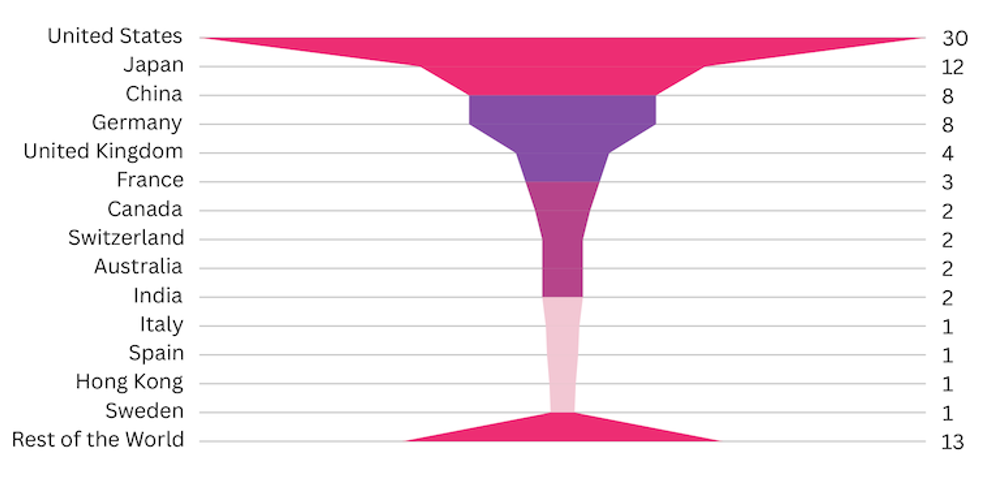
Based on the exponential increase of millionaires in China, you can quickly deduce that China’s economic system is not the old communist system that existed in East Germany and the USSR. In 2023, a consulting firm predicts that 13,500 Chinese millionaires will relocate to other countries (Gordon 2023). The most cited reasons were to seek better educational and employment opportunities for their children and economic security for themselves. The Chinese borders are wide open, and nearly anyone requesting a passport will receive one. This emigration policy is in dire contrast to the communist countries of the past.