
Notes: How many conversations can you remember over the last month? What about encounters from six months ago or last year? Are some of your memories lost forever? This may all change with scientific advances that allow you to capture every second of your life via wearable technology, referred to as “lifecasting.” Imagine being able to say, “July 21st, 2021, between 8:00–11:00 p.m.,” and instantly, a recording of your life at that time appears on your wearable electronic device. With another voice command, you retrieve all the text messages, phone calls, and the names of every person you interacted with during the three hours.
Social Status
Your status set, the collection of statuses held at one time, can include student, teammate, worker, and kinship statuses such as son/daughter, brother/sister, boyfriend/girlfriend, husband/wife, and father/mother. Status is often used in the context of an inferiority-superiority scale based on socially approved and defined characteristics and attributes. Remember that social status is socially constructed, meaning that members of society determine who and what is considered low and high status. For example, the women in the Mursi tribe in Ethiopia (photo) are viewed as having status in their culture since they choose to stretch their lips and ears with clay plates. In the U.S., a lip plate would likely carry a social stigma rather than an elevated social status. Ear gauging is growing in popularity in the U.S. and Western European countries. In some social circles, having a 30mm size hole provides social status, while others perceive it as undesirable. What other practices have varying degrees of social status, depending on location?
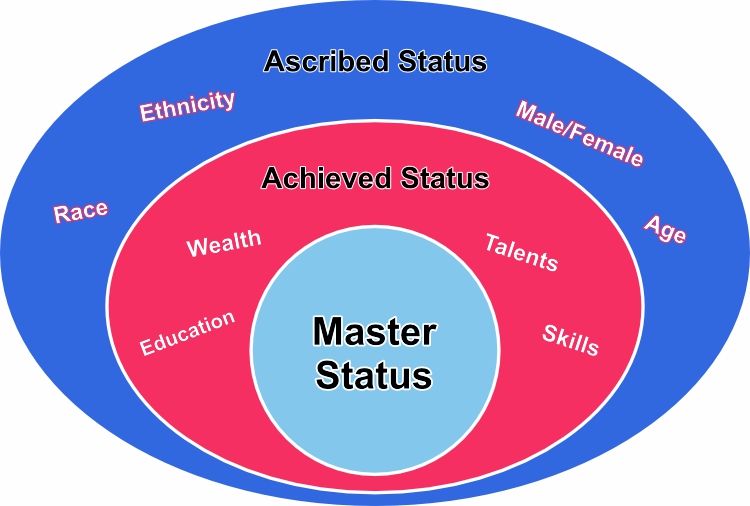
We are born with some levels of status, and we can work to earn status, which can be shattered due to poor decisions. Ascribed status, assigned social status based on characteristics such as sex, race, and age, is a helpful measurement in determining your level of status.
Ascribed status is easily recognizable. Individuals did not earn their ascribed status based on hard work, skills, or talents but merely because they were born a certain way.
Achieved status, earned social status based on merit, is another way to measure your social position within society.
You only have one master status, the social position central to your identity (HP). Your master status may be a college student, a parent, or a college athlete, depending on your life experiences and situation.
Social Roles
social roles, expected patterns of behaviors for specific statuses and positions. There are expectations, informed by social structures, regarding how you are supposed to act in nearly every social situation. Your conversations are shaped by society, and you abide by its unstated but standardized roles. Specific roles have similar expectations for everyone who is in the same role. For example, how are you expected to behave in the role of a college student?
Role strain, incompatible demands, and expectations within a single role (HP), occurs when you are being pulled in too many directions as a student. Does it seem that exams fall on the same day and papers and group projects are due the same week? Have you asked yourself how you can get it all done? If so, you are experiencing role strain, as the demands and expectations of being a college student stretch you to the limit. On top of this, you will undoubtedly experience role conflict, competing demands resulting from two or more statuses (HP). You have to meet the demands of your coursework, family and friends, and extracurricular activities, which can sometimes be overwhelming.
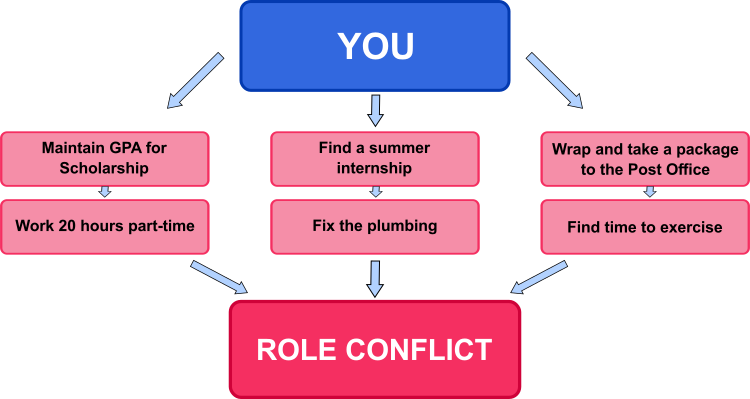
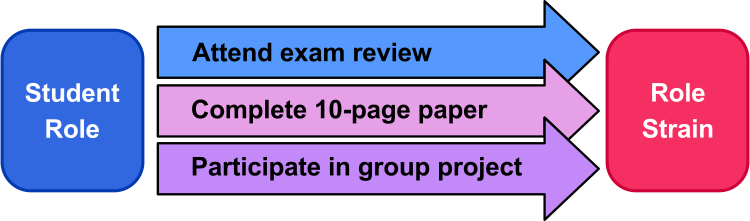
Boston University management professor Douglas Hall (1972) provided the following specific ways to cope with role strain and role conflict through restructuring roles:
- Eliminate role activities but not entire roles.
- Seek role support from outside and inside the role set.
- Integrate roles by redesigning roles to be overlapped and performed simultaneously in a mutually reinforcing manner.
- Problem-solving with role senders to seek assistance in deciding how to redefine one’s roles.
In some situations, implementing these coping mechanisms won’t work, and exiting one or more roles will be necessary.
A role exit, the process of disengaging from significant roles, can be an emotional and challenging process. You are connected to your roles in the past, present, and future, which means it is usually not a simple decision to quit, resign, or walk away. Let’s examine the case of President Donald Trump, who lost his 2024 re-election bid, to learn more about role exits. He claimed that voter fraud occurred in some states, and he utilized legal challenges to attempt to overturn the votes of the 2020 election.The decision to exit is, to some degree, based on one’s role attachment, emotional intensity associated with the role.
In the scenario of the college student overwhelmed with obligations, options include resigning as an officer within the organization or quitting the job. If you have been in the organization for three years and have been a loyal and dedicated member and officer, your role attachment will be strong. If you have been only working at your job for three months, it may be easier to explain your situation to the manager and resign. Sociologist Helen Rose Ebaugh, a former nun, now married with two children, wrote Becoming an Ex: The Process of Role Exit (Ebaugh 1988). She states there are four stages within role exiting:
- Doubt role commitments
- Seek alternatives
- Turning point
- Create an ex-role
The first stage begins when the individual questions and doubts their commitment to the organization. Members and outsiders pick up on these cues, further reinforcing discontent. In the second stage, the individual begins discussing alternatives, especially with others who sympathize with their current role situation.
This is a myth.
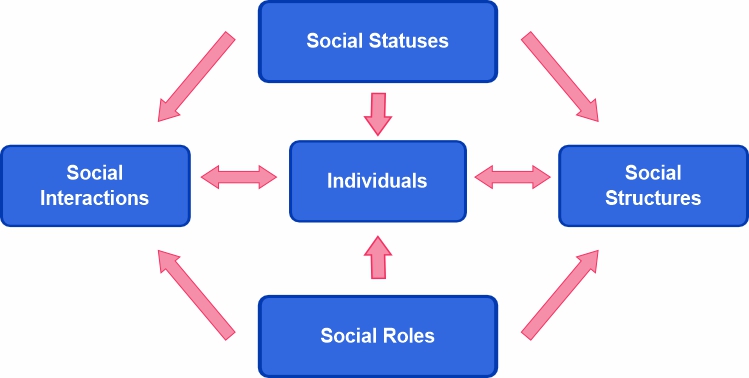
Social structures also impact our interactions, so the relationship is like a two-way street. You may not have realized all of the hidden pieces within social interactions and not have been able to analyze the processes or describe the relationship with social structures. Now, you can stop to ponder the intricacies and complexities of your last conversations as a reminder of how sociology can help you make sense of your daily interactions and social world. Next, we will continue our discussion of social interactions and learn what happens when interactions go awry.
Family, government, education, religion, and economics are examples of social institutions, organizational systems that link individuals to the larger society (HP). Within these social institutions are systems of behavioral and relationship patterns interwoven and enduring throughout society. While there are similarities among social institutions across societies, how they are structured and expected to behave may vary from culture to culture. Governments can be found in the United States, Britain, and China, but the types of government and how they conduct business vary tremendously. All social institutions serve the function of providing society’s basic needs and defining the dominant social values. For example, the family serves the function of providing security for its members and teaching values. Social interactions occur within social institutions and contribute to developing the systems of behavioral and relationship patterns that create and maintain society.
While social institutions contribute to society’s overall well-being, they can experience a range of problems that can impact society and individual members. Table 5.3.1 provides an overview of the five major social institutions and addresses some of the problems associated with each one
Social Institutions
Family: The family is a social institution that contributes greatly to society by socializing members, regulating sexual behavior, and creating a sense of belonging. Families accomplish this by rearing children, caring for the elderly, imparting norms and values, and passing culture from one generation to another. The family also passes along its social class position within society from one generation to the next
Disadvantage: instability in the institution of the family may manifest as a rise in the rates of single parenting, divorce, and domestic violence in society. Problems in this social institution may result in families having difficulty regulating their members’ behavior and offering a stable foundation in which to raise children or care for the elderly in their time of need. The transmission of social class via the family contributes to social inequality and works to maintain stratification in the larger society.
GOV: As a social institution, the government plays a key role in establishing order in society and regulating social behavior. Additionally, governments work to mediate disputes between parties within the society, plan, and establish the direction for the future, protect citizens, and maintain relations with other societies.
Disadvantage:A breakdown in the institution of government can occur when leaders or agencies are unable or unwilling to fulfill their stated functions. This may result in citizens losing trust in the political process and their leaders. A lack of trust in the government regulations, and fear that the political agencies and leaders are not looking for citizens’ best interests. Extreme forms of government mistrust may result in citizens protesting and taking steps to overthrow the gov
Religion: Religion as a social institution is important to the socialization process because it helps indoctrinate citizens with values and beliefs. Typically, these values and beliefs are in line with the norms of the larger society. Religion works to comfort its members by providing answers to unanswerable life and death questions and by offering a sense of belonging, connectedness, or group unity. Religious institutions may also be instrumental in rallying members to take action around a particular social cause, as was the case with African American churches during the civil rights era
Disadvantage: As a social institution, religion has problems when its leaders act in ways that result in harm to its members or the larger society. Additionally, when religious institutions try to indoctrinate members with values and beliefs in opposition to the dominant culture, the result can be a confrontation with other members of society and law enforcement officials.
Economics:Economic institutions are instrumental in the distribution and regulation of financial resources in society. They are important to the manufacture of goods and services and fuel the creation of jobs.
Disadvantages: Issues with economic institutions arise when the financial resources are concentrated in a few members of the society. In particular, the banking industry has been accused of catering to the needs of the wealthy while ignoring or misleading the middle class and the poor. Changes in economic institutions can have a ripple effect on society by impacting production and job creation in society.
Social Groups and Networks: Our Connections to Each Other
Social groups, two or more individuals connected by common bonds and shared social relations, are basic elements of society. Sociologist Charles Horton Cooley (1864–1929) divided social groups into primary groups, small-scale, intimate face-to-face long-lasting associations, and secondary groups, large-scale, impersonal, task-focused, and time-limited associations (Cooley 1909). Primary groups are small-scale and share personal and lasting relationships. Examples include family members, childhood friends, and intimate partners. Ideally, all of these interactions consist of personal and lasting relationships that provide security and meaning among its members.
In contrast, secondary groups are often large-scale, impersonal, task-focused, and time-limited. Employees working in a store like Walmart qualify as members of a secondary group. The interaction in this type of setting is geared toward completing the business of the day, not establishing long-lasting intimate connections. Other examples include political parties, unions, and workers at a college or university.
The Personal and Public Nature of Emotional Interactions
Many societal guidelines dictate how we, as individuals, are supposed to act in a given situation. These general rules vary depending on whether our society emphasizes the importance of the individual or the group as a collective. While one society may praise public shows of emotion, another might see such behavior as an inappropriate display that places too much attention on the individual. Across cultures, there are examples of varying emotional responses, even in extreme situations.
Emotions can be divided into two groups. They can be either prescriptive, which tells us how we are supposed to behave, or proscriptive, which tells us how we are not supposed to behave. In Western society, a person is supposed to be joyful at weddings but not at funerals. The dictates about prescriptive or proscriptive emotions are known as feeling rules, norms about which emotions are appropriate to display in a given situation (HP). Every society has feeling rules about how people show their emotions and what emotions are acceptable or unacceptable to express.
. This is known as emotion labor, a worker’s regulation of personal feelings in an effort to set an emotional tone for customers in a business setting (HP). First identified by sociologist Arlie Hochschild in her research on flight attendants, emotional labor requires workers to manage their emotions to enhance customers’ experience, regardless of how the workers may actually be feeling at the time (Hochschild 1989). What happens if employees, like flight attendants or pilots, can’t manage their emotions? In some instances, the employee might have a confrontation, as was the case in 2010, when Jet Blue flight attendant Steven Slater got into an argument with a passenger, used the plane’s speaker system to curse other members of the cabin crew, deployed the plane’s emergency slide, and slid off the plane onto the JFK International Airport tarmac holding a beer in his hand (Mayerowitz 2010). In the worst-case scenario, an individual’s inability to control emotions could result in death, as was the situation in 2015, when flight investigators concluded that Germanwings Flight 9525 crashed due to pilot suicide, killing all 150 people on board (Kulish and Clark 2015).
Emotion labor in a work environment only occurs when the employee works in close proximity to the public. A city traffic control monitor who spends his time staring at a computer screen need not engage in emotion labor because he isn’t dealing with the public. On the other hand, restaurant servers must make a concerted effort to control their emotions because their tips may depend on keeping customers happy.
Harassment: Unwanted Interaction
Sexual Harassment
Any welcome sexual conduct deemed offensive by the recipient. It can be verbal, physical, or sexual in nature.
Racial Harassment
Unwelcome verbal or physical behavior directed towards an individual(s) based on their race or national origin.
Personal Harassment
Bullying, rejecting, humiliating, intimidating, and uncivil conduct directed towards someone based on personal difference.
Sexual Orientation Harassment
Unwanted verbal, physical, and sexual conduct directed towards someone based on their sexual orientation.
Disability Harassment
Negative physical or verbal behavior directed towards an individual based on their mental or physical ability.
Age Harassment
Hurtful physical and verbal actions directed at a person based on their age.
