
Notes:
| Sex |
Biological and anatomical variances between males and females |
| Sexuality | An individual’s experience and expression as a sexual being |
| Gender |
The socially learned expectations and behaviors associated with being a man or woman |
binary, the belief that there are only two distinct and opposite categories
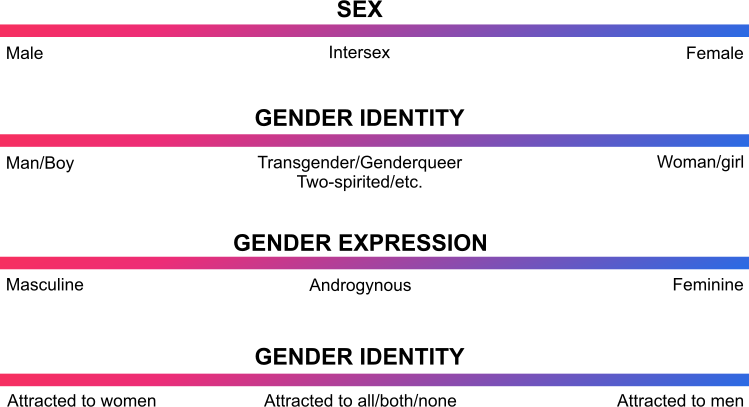
gender nonconforming, an individual whose behavior and/or gender expression do not conform to society’s norms for masculine and feminine
masculinity, traditional behaviors and traits associated with men (HP),
and femininity, traditional behaviors, and traits associated with women,
feminine-expressive role, providing care and emotional support,
masculine-instrumental role, goal-oriented and providing financial support,
intersex, a person born with variations in male and female hormones, chromosomes, and/or sexual organs,
| Gender Nonconformity | An individual whose behavior and/or gender expression does not conform to society’s norms for masculine and feminine. |
| Genderqueer | A person whose gender expression and/or identity is neither masculine nor feminine. Genderqueer is sometimes used synonymously with non-binary or gender fluid. |
| Cisgender | An individual whose gender identity matches their sex at birth. |
| Transgender | A person who identifies with a gender that is different from their biological sex. |
gender norms, behaviors, or traits that society attributes to a particular sex
gender roles, public expression of one’s gender identity
sexism, prejudice, devaluation, and discrimination based on an individual’s sex
second shift, the unpaid childcare and household responsibilities completed by women that are in addition to their paid work in the labor force.

Gender stratification, the unequal access and distribution of wealth, power, and privilege between women and men
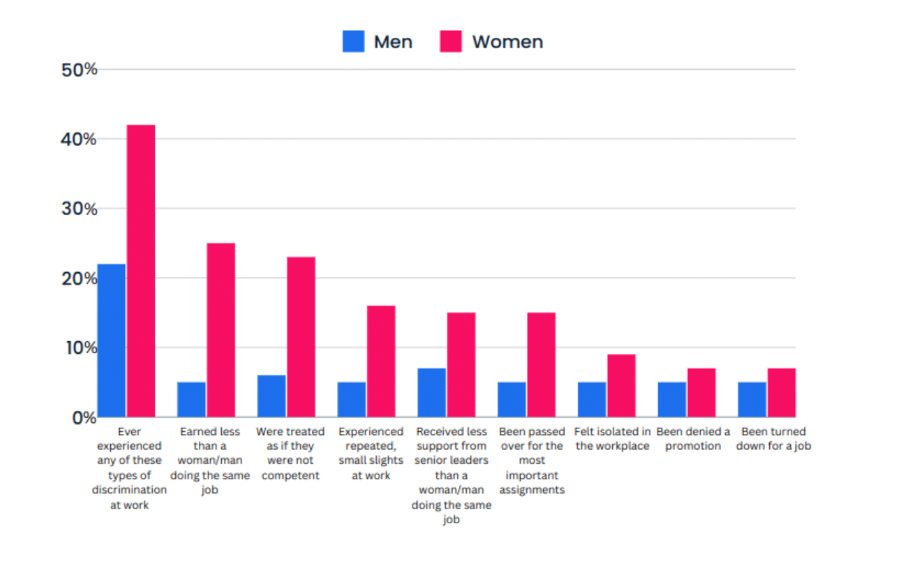
glass escalator, which means that men in female-dominated careers rise faster than women in male-dominated careers
glass ceiling, social and legal barriers designed to prevent minorities and women from advancing in the workplace
Sexual harassment, unwelcome sexual advances, requests for sexual favors, and other verbal and physical harassment of a sexual nature
uid pro quo, express or implied demands by an employer or supervisor for sexual favors in exchange for some benefit such as a promotion, raise, or preferential treatment
hostile environment, an intimidating, hostile, or offensive working environment due to unwelcome verbal or physical conduct of a sexual nature
intersectionality, the overlap of personal and social identities that manifests as disadvantage and discrimination in people’s lives
|
U.S. College Degrees by Gender |
|||||||
| Degrees |
Class of 2017 |
Class of 2026 (estimated) |
|||||
| Percentages | Females per 100 Males | Percentages | Females per 100 Males | ||||
| Male | Female | Male | Female | ||||
| Associate’s | 37.9% | 62.1% | 164 | 34.9% | 65.1% | 187 | |
| Bachelor’s | 42.9% | 57.3% | 134 | 41.8% | 58.2% | 139 | |
| Master’s | 41.7% | 58.3% | 140 | 41.6% | 58.4% | 140 | |
| Doctoral’s | 47.8% | 52.2% | 109 | 47.6% | 52.4% | 110 | |
| All Degrees | 41.5% | 58.5% | 141 | 40.0% | 60.0% | 150 | |
honor killing, the killing of a female family member for the perceived shame she has brought onto the family,
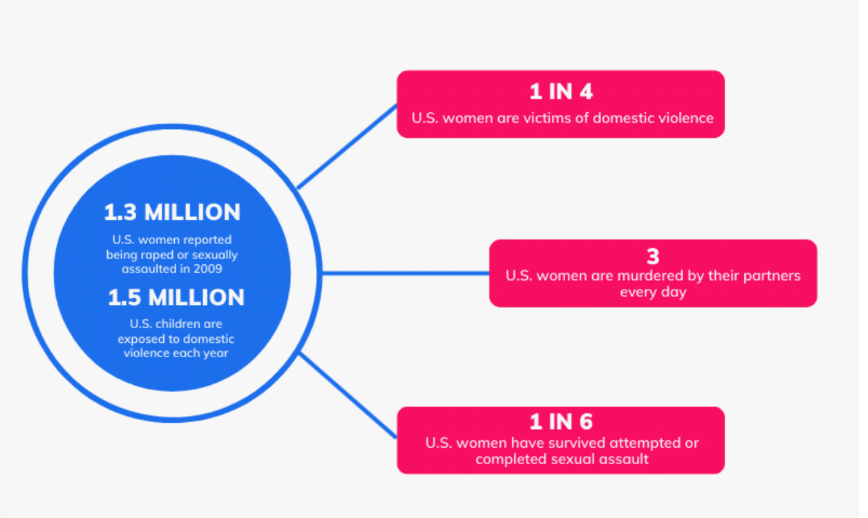
violence against women, any act that results in the mental, physical and/or sexual harm of a girl, teen, or woman
| Concept | Definition | Explanation |
|---|---|---|
| Social Learning Theory | Individuals who witness or experience violence while growing up are likelier to use violence as adults. | A little boy who witnesses his father beat his mother may see the behavior as normal and grow up to be abusive toward his partner. |
| Social Situation or Stress Theory | Violence is greatly influenced by the stress in a particular situation that may be part of the larger society or specific to a particular group. Also, culture may work to normalize violence in society. | Whether caused by an individual’s job loss or a nationwide recession, financial problems in a family act as a stressor that may increase the likelihood of violence against women. Cultural norms that promote violence include violent movies and video games. |
| Resource Theory | One perspective on this theory states that the more resources an individual has, the more control and force he can apply in the relationship. On the other hand, some contend that the fewer resources a person has, the more likely he is to compensate by resorting to violence. | A person who controls the family finances and makes all the decisions has greater resources at his command than one who shares responsibilities with his spouse. By contrast, a suddenly unemployed person may resort to violence towards his partner to compensate for his lack of income and perceived loss of power. |
| Exchange Theory | Based on the economic principles of costs and benefits, this theory contends that an abuser will use violence when the benefits exceed the costs. | An abuser knows slapping his partner means that she will do as he demands and will not call the police on him, therefore costing him nothing. |
| Feminist Theory | Looks at the history of male domination in societies worldwide and contends that larger social and economic processes work to subordinate women in society and the home. | Paying women less money than men, not valuing their work in the home, and not having laws to protect women in the event of violence puts them in a lesser position in society and the home. |
| General Systems Theory | The violence experienced by women isn’t just about the individual abuser but about the family systems or structure overall, which is made up of multiple people that play varying roles that are changeable over time. | An abusive husband injured on the job and can’t work may find his position in the family system changed when his formerly dependent wife becomes the family breadwinner. |
microaggressions, words, and deeds that negatively impact marginalized individuals, groups, or communities,
| Microassaults | Derogatory comments or actions | Hate speech
Avoidance Negative representation |
| Microinsults | Snubs and hidden insults | Entitlement and assumptions made by the heterosexual community. For example, saying, “You don’t look gay.” |
| Microinvalidations | An attempt to negate the feelings and experiences of others | Diminishing a person’s gender or sexual orientation. For example, saying, “You are being too sensitive.” |
| Sexuality | Sexuality is similar to but different from the term “sex.” Therefore, “sex and gender” and “sexuality and gender” represent two distinct concepts. Sex is biological, while gender is a social construction. Instead of being strictly about biology, sexuality refers to the expression of the individual’s behaviors and desires. |
| Sexual Orientation | An individual’s sexual interest toward the same, opposite, neither, or both sexes. Sexual orientation is a means of expressing oneself as a sexual being. |
| Heterosexual | Individuals with a sexual interest in the opposite sex. |
| Homosexual | Individuals with a sexual interest in the same sex. |
| Bisexual | Individuals with a sexual interest in both sexes. |
| Asexual | Individuals who are not sexually attracted to others. |
| Pansexual | Individuals who are attracted to all people regardless of their gender identity or sexuality. This attraction can be emotional, romantic, and/or sexual. |
hookups, a sexual encounter, usually lasting only one night, between two individuals who are strangers or brief acquaintances
homophobia, the fear of homosexuals, and homosexuality.
heterosexism, prejudice, or discriminatory attitudes and behaviors against homosexuals and homosexuality.
transgender, a person who identifies with a gender different from their biological sex
sex reassignment, the process of having surgery and taking hormone medications to become the opposite sex
feminism, a social movement that aims to establish equality between the sexes.
men’s rights movement, an effort to establish the employment, sexual, and familial rights of men
gay rights movement, individuals and organizations seeking to establish legal and social equality for members of the LGBTQ+ community
allies, someone who advocates and supports the push for equal rights,
feminists, a person who believes in the legal, political, social, and economic equality between the sexes,
| Date | Phase | Overview |
|---|---|---|
| 1848 to 1960 | First Wave of the Women’s Movement | During this first wave of feminism, the focus was primarily on equality in the home and increasing social and political opportunities for women. The issues being addressed challenged the cult of domesticity, the glorification of White middle to upper-middle-class ideals that placed value on women for their sexual purity, morality, domestic abilities, and submissiveness to men. |
| 1920 | Women’s Right to Vote | The victory of the 19th Amendment to the Constitution did not apply to all women. While early on, the first wave of the Women’s Movement was closely tied to the abolitionist movement to end slavery and promote racial equality, the resulting victories were criticized for focusing on the issues of White middle and upper-class women while doing little to address the concerns of poor or minority women. |
| The 1960s to 1990s | Second Wave of the Women’s Movement | This wave of the Women’s Movement focused predominately on issues of sexuality, reproductive rights, and the cultural and political inequality experienced by women. |
| 1964 | The Civil Rights Act | This piece of legislation outlawed discrimination against women and minorities. |
| 1965 | Voting Rights Act | This legislation gave minorities the right to vote. |
| 1972 | Title IX | The law forbids educational discrimination against women in academics and athletics. |
| 1973 | Roe vs. Wade | This case legalized abortion in all 50 states. |
| The 1990s to Present Day | Third Wave of the Women’s Movement | This wave has focused on the experiences of minority women that were overlooked in the first and second waves. In particular, the sociologist Patricia Hill Collins helped broaden the third wave beyond that of a White middle-class cause by introducing theory based on the matrix of domination, the idea that oppression is multifaceted. As explained by Collins, oppression is not mutually exclusive, and a person can experience oppression in different ways and in combination based on their gender, race, age, social class, religion, and sexual orientation. |
queer theory, a perspective that emerged in the 1990s, challenging the normative assumptions of heterosexuality and homosexuality.