Notes:
A Sociological Perspective on Deviance
In many ways, this recognition is how we learn to be “normal” members of society. Do you know individuals and groups who engage in deviance, violation of social norms, and don’t “fit the mold”?
most cases, you consider the agents of social control, informal and formal groups that control the behavior of members of society, such as what your family members, friends, acquaintances, and general members of society deem acceptable. Your friends serve as a mechanism for informal social control, individuals and groups that unofficially reinforce social norms, as they remind you when your behavior goes against the norm. Otherwise, there would be more guys with mullets and soul patches wearing parachute pants! There are also mechanisms for formal social control, groups and organizations whose specific function is to control the behavior of members of societies and reinforce social norms (C-19). Examples of these formal controls are high school administrators and law enforcement agencies. Even with informal and form social control mechanisms, why do individuals still choose deviant behavior?
The Social Construction of Deviance
The key point is that what is considered deviant is determined by society, and it changes over time. Deviance is socially constructed when individuals and groups assign meaning to behaviors. Over time, the behavior is labeled as either acceptable or outside the norms and values of the group members or society. The type of label assigned to the behavior is determined by the social factors of time in history, location, social status, and social context.
Deviance and Time in History
Deviance is relative. There are many examples of social behaviors that were once considered acceptable within society that are now regarded as deviant or illegal. One hundred years ago, divorce was rare and considered a moral failure, and divorced women were labeled as divorcees, a term that carried a negative label (Gerstel 1987). Today, divorce is nearly as common as marriage and does not carry a distinct social stigma, a label associating an individual with a set of unwanted characteristics that form a stereotype. On a different note, “tree hugger” and “environmental wacko” were used in the 1970s as derogatory terms for individuals who wanted to protect trees, spotted owls, and forest ecosystems. Environmentalists were labeled communists and accused of being anti-American since the environmental groups called corporate responsibility and ethics into question. U.S. corporations fought against new governmental regulations, such as the amendment of the Clean Air Act in 1970. To be an environmentalist was deviant behavior that resulted in being socially marginalized. Today, a website called Treehugger.com is one of the leading media outlets dedicated to driving sustainability mainstream. Living sustainably is not only socially acceptable but is also becoming socially desirable. Fortune 500 companies have sustainability directors, and green capitalism is the new model for doing business globally. What was once considered deviant and carried a social stigma 40 years ago is now mainstream and valued by corporations, universities, organizations, and individuals. In the case of divorce and environmentalists, the stigma decreased significantly over the decades. Is this the pattern that most stigmas follow? In other words, do most stigmas decrease or disappear over decades?
Most social stigmas disappear over time.This is a myth
Deviance and Location
Location is also an important social factor in defining deviance.
Deviance can also be viewed based on social status and context.
Labeling Theory
The labeling theory, the idea that individuals labeled as deviant are more likely to act on the label (HP), is grounded in the works of Edwin Lemert and Howard Becker, which focused on deviance, social control, and sociopathic behavior in the 1950s and 1960s (Lemert 1967; Becker 1964; Becker 1963; Lemert 1951). The theory emphasizes the act of being labeled as deviant rather than the reasons for exhibiting deviant behavior. The “why” is not as important as understanding exactly “who” is doing the labeling. In most cases, people of power, such as police, judges, legislators, teachers, and other authority figures, are doing the labeling. Lemert points out that everyone engages in primary deviance, violations of norms that do not result in being labeled as deviant (Lemert 1967). You may have received a traffic violation or overslept for a class and missed an exam, but neither resulted in being labeled a deviant. Secondary deviance, norm violations that result in being publicly labeled as a deviant and outsider, is the second stage in the identity formation of deviance. If the individual repeats the act of deviance, the conforming members of society communicate judgment and negative impressions. This causes the individual to feel alienated. This alienation is a catalyst to join a group that accepts deviant behavior. Some individuals engage in tertiary deviance, normalizing deviant behavior by labeling it as nondeviant (HP). One of the easiest ways to exemplify tertiary deviance is through social movements. For example, homosexuality was classified as a mental disorder from 1952 to 1972 by the American Psychiatric Association. Beginning in the 1970s, gay rights activists mobilized to challenge this label and associated discriminatory behavior and laws. This movement led to laws being changed, such as the legalization of same-sex marriage in 2015. These changes have resulted in a gradual normalization of same-sex relationships, thus significantly reducing the deviant label.
Differential Association Theory
Differential association theory, a process by which individuals learn deviant and criminal behavior from associating with deviants and criminals (HP), is the second micro-level theory. Developed by Edwin Sutherland (1939), the theory asserts that deviance, specifically criminal behavior, is a learned behavior. He proposed that when communication includes more negative than positive prosocial messages, individuals are more likely to gravitate toward criminal behavior. In other words, if a teenager is around delinquents more often than positive peers, the teenager will more likely follow the crowd toward a path of juvenile delinquency.
Sutherland specifically stated that when criminal behavior is learned, the learning includes techniques of committing a crime, an offense in violation of public law (HP), and the criminal’s motives, drives, rationalizations, and attitudes. If an individual is exposed early and often to individual criminals who are viewed as having high status, the individual is more likely to follow in the footsteps of the deviant role model. A 10-year-old living in a high-crime neighborhood may be exposed to gang members daily. He is much more likely to overhear the motivations for crimes and observe criminal behavior. At some point, there may be more social messages favoring law-breaking than messages favoring law-abiding, resulting in the boy becoming a lookout, a runner, or a graffiti writer for a gang. He will have been exposed to these activities and social messages by living in the neighborhood his whole life, making him a likely candidate to join a gang. Sutherland also argued that the learned behavior comes from intimate personal groups rather than from the media.
Control Theory
Travis Hirschi developed the social control theory, which states that individuals who do not have enough strong social bonds are more likely to feel disconnected from society and engage in deviance and crime (HP), to explain how individuals become delinquent (Hirschi 1969). He believed that all humans have the natural and biological tendency to be delinquent, but that we learn to conform to social norms due to the socialization process and the internalized norms that act as social control methods. Social bonds that promote social order and conformity exist between individuals and society. When social bonds are weak, delinquency is more likely to occur. Social control theory argues that attachment, belief, commitment, and involvement encourage conformity and are predictive of delinquency (Wiatrowski, Griswold, and Roberts 1981).
- Attachment: The family is the attachment source, as parents provide support and teach children socially acceptable behavior.
- Belief: The level of acceptance of the social values of society.
- Commitment: An individual’s focus on achieving socially accepted goals such as a high school or college degree and a high-status job.
- Involvement: Participation in conventional activities that lead to socially accepted goals.
These factors are related to strong social bonds, primarily to parental attachment, which is practically absent in Nicole’s life. There are also internal and external control mechanisms that are impacting Nicole.
The containment theory, the idea that individuals have various social controls (containments) that provide a protective barrier to help them to resist engaging in deviant and criminal behavior, states that individuals have internal and external control mechanisms that serve to control one’s behaviors (Reckless 1970; Reckless and Dinitz 1972). These inner and outer containments are the mechanisms that combat external pressures. Inner containment refers to the conventional behavioral values and personality characteristics that provide the means to resist criminality. There are social forces that predispose or protect you from criminal behavior. The external social pressures that push individuals toward crime include poor housing and economic conditions, minority group membership, and the lack of legitimate opportunities to achieve success. Individuals are also pulled away from social norms by peers, deviant subcultures, and media (Hagen 2010). For instance, Nicole lives in adverse economic conditions and may not have many opportunities to succeed due to her family situation. She is influenced by peers who use drugs and associate with a gang (a deviant subculture). Does Nicole possess strong self-esteem and a work ethic? Outer containment consists of parental, familial, and peer support that reinforces conventional norms, values, and beliefs
Limitations of Micro-Level Theories
As with all theories, there are limitations and weaknesses for each micro-level deviance theory.
The labeling theory ignores individual acts of deviance and the process that leads to deviant acts. The theory focuses primarily on how persons of authority determine the labels and the response to the labels. The differential association theory discounts individuals as rational and independent actors who don’t always succumb to group mentality. Another criticism is that it is difficult to measure the effects of frequency and duration of associations on the propensity to learn deviant behavior. Criticisms of the social control theory include whether weak attachments lead to delinquency or delinquency leads to weak attachments. Also, some criminals have strong bonds with family and friends but still commit crimes. In the next module, we will discuss a subset of the social control theory involving micro and structural components, then investigate structural issues contributing to deviance and crime.
Structural Explanations for Crime
You can’t escape crime. Many people move from large cities to small rural towns to avoid the crimes they experienced in the big city. Much to their surprise, they still experience crimes such as theft and vandalism. The micro-level theories help understand the individual circumstances that lead individuals to a life of crime, but they do not explain the structural issues contributing to criminal activity.
Structural Strain Theory
structural strain theory, the theory that social structures can promote crime and deviance among individuals within a society (HP). When society is in balance, individuals seek culturally accepted goals through culturally approved means. When members of society cannot achieve these goals, tension and strain occur, and some individuals seek other ways to obtain the goals. Merton indicates that structural issues such as poverty, unemployment, and access to quality education create these roadblocks and strains. He borrows Durkheim’s term anomie and redefines it as “discontinuity between cultural goals and the legitimate means available for reaching them” (Merton 1968). In other words, if you can’t get over the mountain, tunnel underneath it or go around it. By doing so, the culturally accepted goal is achieved, but by deviant means. If you can’t afford a luxury car, consider going to the casino every weekend to gamble so you can win enough money to purchase a new BMW. A more conventional means of acquiring a BMW is to attend high school and a university to gain a degree and be gainfully employed.
There are instances in which deviance can be beneficial to society. This is true
As Durkheim explained, deviance plays a positive function in society because it affirms cultural norms, clarifies moral boundaries, unites groups of people, and encourages social change. How often have you observed students at your college or university participating in deviant behavior and noticed the looks or stares other students give them? Students who habitually walk into class tardy are often met with stares from some of their peers. These stares are meant to communicate to the late student that they are inconsiderate and disrupting the class. Their feedback sends a clear signal regarding unacceptable behavior and reinforces norms and acceptable behavior among college students. The result is that, most often, students are on time for class, which eliminates disruptions and optimizes all students’ learning experiences.
Merton acknowledged that some individuals experience roadblocks. For instance, economic prosperity is a culturally accepted goal. For some, economic prosperity may mean making $20,000 a year, while anything below six figures is unacceptable for others. In each case, a steady job and a reasonable work ethic are required. But consider a child whose parents are unemployed and have substance abuse problems. Education is not emphasized, and there are food security issues in the home. The child’s main priority is to get enough to eat each day. Homework is not even on that list of priorities. Eventually, the child reaches high school and is still reading at a third-grade level. This causes the child to realize that graduating high school is an unattainable goal. Can this teenager reach the goal of economic prosperity? What other options are available — positive and negative?
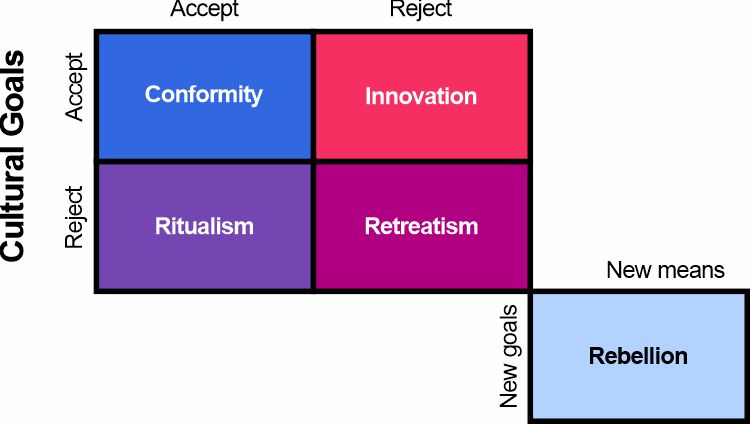
Critics of Merton’s structural strain theory indicate that the theory does not explain some types of white-collar crime, nonviolent and financially motivated crime (HP), such as bank and insurance fraud, money laundering, and Ponzi schemes. In many cases, wealthy business executives commit fraud or engage in financial scams. Bernard Madoff’s Ponzi scheme bilked investors out of $50 billion through his wealth management firm (Washington 2012). He received a 150-year sentence. It can be argued that he did not experience structural strain, as he had already achieved his fortune when he turned to illegitimate and criminal means. Another weakness in Merton’s theory is that it is based on conformity being the norm in society and that everyone must strive to achieve culturally accepted goals. It ignores pluralism and discounts alternative goals as desirable by many members of society.
Let’s consider that larceny theft happens every 6.2 seconds. The structural strain theory explains that many teenagers cannot acquire trendy and expensive shoes, an iPhone, or car purchases. Therefore, they turn to alternative means of achieving culturally defined goals through car burglaries. Do you know anyone who has left valuables in their car whose window was smashed and their valuables grabbed? This type of crime is most often carried out by juvenile delinquents (innovators) looking for electronics or other valuables to sell at a pawn shop. Therefore, the juveniles believe the acceptable means to achieve the culturally defined goals are blocked and turn to crime instead. The last macro-level theory addresses why the goals are blocked.
Conflict Theory
Crime can be described as being perpetuated among the poor due to economic and social forces. Teenagers living in low-income and high-crime inner-city neighborhoods may not own a car and be able to drive to and afford private tutoring after school. In fact, it may not be safe to go outside of their apartment alone at night. This can impact their GPA, scores on the ACT and SAT, and their ability to participate in community service after school. These limitations can lead some students to look for alternative means to reach what is defined as “success” in the U.S. Believing that one has limited opportunities due to socioeconomic conditions can lead individuals to turn to criminal behavior to achieve success. Marxists attribute crime resulting from this type of behavior to class struggles and limited opportunities for the poor. The dominant class controls most resources, thus limiting the means of lower classes to achieve culturally acceptable goals. The elite can afford private secondary schools and universities and professional schools such as law and medical schools. Discrimination against the lower social classes exists in the workforce, making it difficult to rise above their circumstances. Even a college student who can’t afford a tailored and freshly pressed business suit may not be invited back to the second interview based simply on their appearance. Faced with exploitation and an imbalance of resources, some members of the lower classes may turn to alternative (criminal) means to achieve culturally acceptable goals.
Critics argued that the law was racist, detailing that it is the same drug in a different form and that crack cocaine is associated with inner-city minorities while powder cocaine is associated with affluent whites. The trend would see inner-city minorities getting arrested, prosecuted, and serving prison time for crimes related to crack, and affluent whites often receiving lenient or no sentence for crimes associated with cocaine. This type of legal mandate is an example of a policy intended to reduce structural strains and roadblocks for some lower-income communities. The policy is a step toward leveling the playing field for Black and Brown communities to allow them a more unrestricted pursuit of the American Dream.
Problems of Justice in America
incarceration rate, the number of people in state and federal prisons
Categories of Crime
When a person or group engages in deviant behavior that violates significant social norms, they may find themselves immersed in the criminal justice system, formal institutions designed to enforce, arbitrate, and carry out the laws of society. The criminal justice system in the United States is made up of three parts:
- police and law enforcement
- courts
- the penal system
A crime in which a person is physically harmed or threatened by the forceful behavior of another.
Examples: murder, assault, rape, kidnapping, and harassment.
Public Order Crime
Crimes that violate the norms and standards of a community or impair a person’s ability to function.
Examples: prostitution, pornography, alcohol, and drug usage.
A nonviolent crime committed by a person during their employment or financial affairs.
Examples: identity theft, bribery, tax fraud, and falsifying records.
A crime committed by a business or an individual on behalf of the business (HP).
Examples: false advertising, stock fraud, bribery, and money laundering.
Crimes or illegal activities committed by members of a gang, the mafia, or the mob.
Examples: extortion, the manufacture and distribution of illegal drugs, human trafficking, and counterfeiting money.
Action or the absence of action that influences the political process.
Examples: voter fraud, the misuse of government funds, bribery, and treason.
Many of these crime types can be expanded further to include subcategories of other behavior that the society sees as problematic. Cybercrime, a crime that targets the computer systems of an individual or group, includes online hacking (HP) and is often associated with organized crime groups. The categories of violent crime and property crime can also include hate crime, criminal behavior directed at individuals or groups based on their race, ethnicity, disability, gender identity, sexual orientation, or religion. While hate crimes may be limited to hateful language, they often involve physical force and property destruction designed to harm and intimidate others. Finally, terrorism, the use of violence or the threat of violence to influence the political process, is a form of political crime. Terrorism is not just criminal behavior; it is politically motivated and used to incite fear in the population to change society’s overall structure.
The incidence of each crime type is known as the crime rate, a statistical count of different categories of crime compiled by federal, state, and local agencies. The Federal Bureau of Investigation collects the most reliable statistics in the Uniform Crime Report or UCR, a government report on the country’s crime rates. The UCR’s accuracy is often questioned due to U.S. police agencies’ differing collection and statistical calculation methods. Additionally, police misconduct and unfair prosecution, sentencing, and incarceration also play a role in influencing the data.
Policing in America
Policing and Subjectivity
Did the police officer issue a ticket or a warning? Like many others, that decision falls into the gray area of law enforcement, which includes deciding whether to stop, search, arrest, or even charge people for their actions. While it is logical that law enforcement officers should use their judgment to separate minor infractions from violations that endanger society, the freedom that discretion affords opens the door to subjectivity, individual bias, and possible abuses of power.
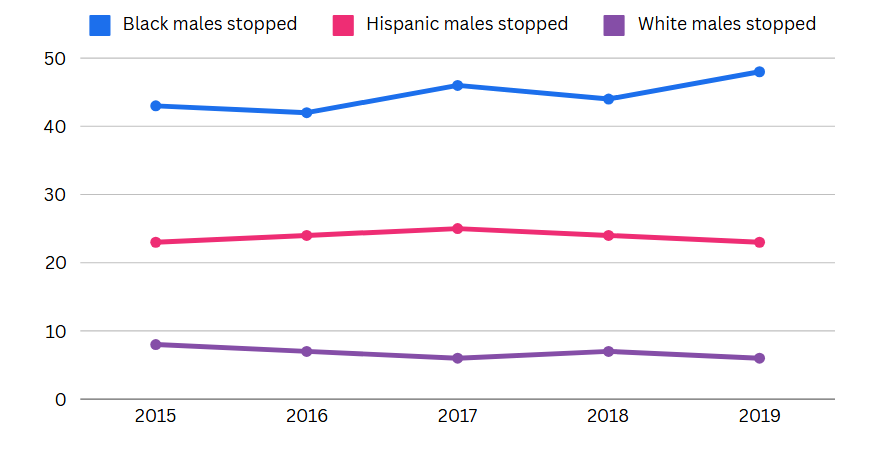
The most recent large-scale review of police misconduct found that in 2010, 4,861 cases of misconduct were reported involving 6,613 officers. There were 6,826 victims and fatalities in 247 instances (Packman 2011). These incidents often target certain segments of the population. Consider the experience of Blacks and Hispanics, who are overrepresented in everything from traffic stops to murder arrests. This differential justice, differences in how groups are treated in the criminal justice system, can be examined by comparing the stop, arrest, and incarceration of Black and Hispanic males to their White counterparts.
Police Brutality
Police brutality is also a type of misconduct associated with this branch of the criminal justice system. Police brutality occurs when officers violate an individual’s rights, often in a manner that involves the excessive use of violence. The following cases offer examples of police brutality in the United States. Can you think of others?
- In 2023, Tyre Nichols was driving and stopped by Memphis, TN police. He was pulled from his car before being pepper sprayed and tasered. He ran from the police and was apprehended by five Black policemen and physically assaulted. Mr. Nichols was taken to the hospital, where he died three days later (Alfonsa, Carter, and Pereira 2023).
- George Floyd died in 2020 while being arrested after a white police officer, Derek Chauvin, knelt on Floyd’s neck and back for 9 minutes and 29 seconds. Mr. Floyd stated he could not breathe and became unconscious during the arrest. Chauvin was convicted on two counts of murder and one count of manslaughter and was sentenced to 22.5 years in prison.
- In 2019, the case against NYPD police officer Daniel Pantaleo was dropped in federal court concerning Eric Garner’s death in 2014, resulting in “I can’t breathe” becoming a rallying cry across the nation. Many argue this is an example of police brutality, but a U.S. attorney ruled the government could not prove the officer used excessive force to violate Mr. Garner’s rights (Benner 2019).
- In 2016, Minnesota police officer Jeronimo Yanez opened fire on Philando Castile during a traffic stop as Castile reached for his identification. Castile’s fiancée, Diamond Reynolds, and her 4-year-old daughter were in the car at the time. Reynolds live-streamed the 74-second traffic stop and killing on Facebook. Castile died at the scene. Officer Yanez was found not guilty on all counts in 2017, resulting in several hundred protestors that decried the verdict (Smith 2017).
- Rhode Island police officer Edward Krawetz received a 10-year suspension in 2012 for kicking handcuffed Donna Levesque, 44, in the head while she was seated on the ground (Ortiz 2012).
- In 2009, police in Ferguson, MO, mistakenly arrested 52-year-old Henry Davis. Davis was beaten while in custody, then charged with destruction of property for bleeding on the officers’ uniforms. Eventually, it was discovered that the officers lied about the blood on the uniform and lied under oath during the trial (Daly 2014).
- While handcuffed and lying on the ground in police custody, 16-year-old Juan Vasquez of Denver, CO, was assaulted by Officer Charles Porter. Porter jumped on Vasquez’s back and kicked him repeatedly, damaging Vasquez’s kidneys, rupturing his liver, and lacerating his spleen (Osher 2008). Porter was fired from the police force (McGhee 2012).
- One of the most notorious cases of police brutality occurred in 1991 with the videotaped beating of Rodney King by five White police officers. The community outrage over the officers’ acquittal sparked six days of riots in Los Angeles.
The difference between misconduct in the general population and the police force is that, because of their role in the criminal justice system, the impact of poor police judgment can set off a chain reaction that negatively impacts innocent people, or as we will see in the next section, disproportionately targets segments of a population resulting in their overrepresentation in the court system.
The Work of Justice
n individual who has been accused of a crime by law enforcement enters the justice system. Within this system, there are three parts: prosecution, defense, and courts. The prosecution consists of lawyers who represent the interests of the state and federal government. They decide whether there is enough evidence to pursue the case brought by law enforcement against the arrested individual or the defendant. If prosecutors feel there is enough evidence to go to trial, they question witnesses and may negotiate plea bargains, agreements in which the accused pleads guilty to the crime in exchange for a lesser sentence.
In contrast, the defense is made up of lawyers whose job is to defend the accused individual against the state and/or federal government charges. The defendant pays for a defense attorney unless he or she doesn’t have enough money. In that case, the accused may use a public defender, someone whose fee is paid by the government.
Judges in the courts oversee the trial process. A judge’s role is to listen to the arguments presented by the attorneys, accept or reject plea bargains, and sentence defendants that have been found guilty of a crime. In some instances, the guilt or innocence of an individual is decided by a jury, a group of people chosen from the community who decide a case based on the evidence presented by the prosecution and defense lawyers.
Over the years, many people have questioned the jury processes’ fairness. Duke University’s study of over 700 non-felony court cases in Florida in 2012 found that when Blacks were not in the jury pool, the rate of Blacks’ conviction was 81 percent and White conviction was 66 percent. By comparison, when Blacks were part of the jury, the conviction rate for Blacks and Whites was 71 and 73 percent, respectively (Anwar, Bayer, and Hjalmarsson 2012). In the justice system’s sentencing phase, Blacks, on average, receive sentences that are 10 percent longer than Whites who commit the same crime (Kerby 2011). This disparity in convictions impacts the composition of the prison population across the country.
Incarcerated in America
The penal or correctional system consists of jails and prisons designed to house individuals who have been arrested, detained, or sentenced. Jails are local community facilities that typically hold an accused while awaiting trial or after receiving a sentence that lasts less than one year. By comparison, prisons are state or federal facilities that house defendants found guilty of a felony whose sentence is longer than a year.
Minorities in Prison
If we expand our analysis of racial disparities in the criminal justice system to include incarceration rates for the nation’s prisons, then we find the following statistics:
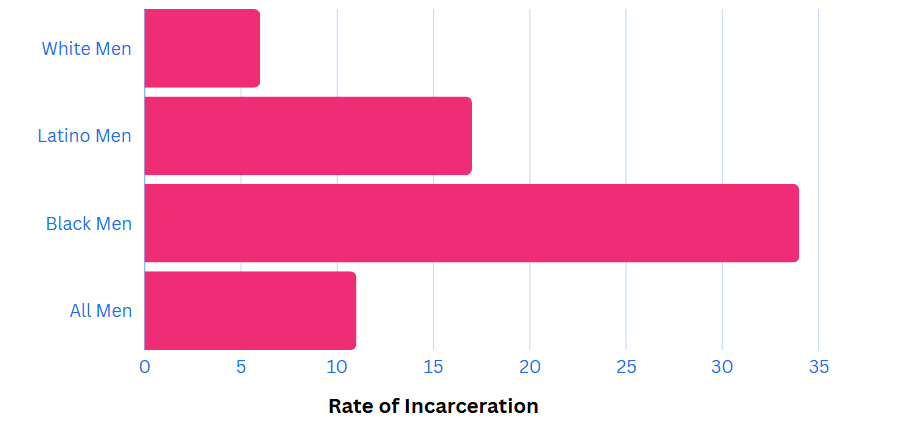
- One out of every three Black boys born today can expect to be sentenced to prison, compared to one out of six Latino boys and one out of 17 White boys (NAACP: Criminal Justice Fact Sheet 2021; Bonczar and Beck 1997).
- While only 12.5 percent of the nation’s drug users, African Americans make up 29 percent of those arrested for drug offenses and 33 percent of those incarcerated for drug crimes.
- If African Americans and Hispanics were incarcerated at the same rates as whites, prison and jail populations would decline by almost 40 percent.
Women in Prison
When addressing the criminal justice system’s problems, it is worth considering whether women’s experience differs from the male population. Although the percentage of men incarcerated (93 percent) far outweighs women in prison, women are the fastest-growing segment of the American prison population, rising 525 percent in 40 years
he issue of disproportionate incarceration rates along racial and ethnic lines with male prisoners can also be found among the female population. African American women have an incarceration rate that is more than twice that of White women, while Hispanic women are 1.3 times more likely than White women to be in prison (The Sentencing Project 2019; Ajinkya 2012). There are approximately one million women under the supervision of the criminal justice system. The following information illustrates trends and statistics related to women in prison.
- The female incarcerated population stands over six times higher than in 1980 (Maruschak, Bronson, and Alper 2021).
- Over half (58 percent) of imprisoned women in state prisons have a child under the age of 18.
- In 2021, only eight states had prison nursery programs that allowed new mothers to bond with their newborns and receive educational training in child development and parenting skills (Barnas 2021).
- Women in prison are five times more likely to have a mental health disorder than women in the general population (Hidayati et al. 2023)
Female prisoners must also deal with incidents of sexual misconduct perpetrated by guards. Seventy percent of the guards in female correctional facilities are men, and sexual assault, sexual extortion, and inappropriate touching during body searches are not uncommon (Amnesty International 2013). Sexual abuse sometimes comes from other prisoners as well. The 1996 case of Robin Lucas illustrates the vulnerability of women in prison. Lucas, convicted of cashing $7,800 in stolen checks, was an inmate in the California prison system. After fighting with another female prisoner, she was transferred to the male wing of solitary confinement, although the transfer was a violation of federal regulations. While in solitary over a two-month period, Lucas’ requests for relocation were ignored. Instead, prison guards allowed male inmates to sexually assault her, including an incident where three inmates were let into her cell to rape her (Amnesty International 2013; Schulz 2001)
Interestingly, sentencing is one area of the criminal justice system that frequently favors women over men. Research has shown that women often receive shorter sentences than males and are more likely to receive non-prison sentences for deviant behavior (Rodriguez, Curry, and Gang 2006). According to law professor Sonja Starr of the University of Michigan, when looking at every phase of the criminal justice system leading up to punishment for the same crime, men receive sentences that are, on average, 63 percent higher than women (Huffington Post 2012; Starr 2012). What is behind this difference? According to Starr, there are several reasons for the differential justice between men’s and women’s sentences. One reason is that, rightly or wrongly, women are often seen as having a minor role in crime compared to their male partners and, as a result, receive a lighter sentence. Another reason is that, particularly in cases where the woman is a mother, the prosecutor and judges are more likely to consider her childcare responsibilities when sentencing. Both of these explanations may have something to do with our collective conscience, a set of shared attitudes, beliefs, and ideas about how things should be in society. It appears that, as a society, our attitudes and beliefs make it difficult for us, and members of the criminal justice system, to reconcile women’s roles as caregivers with their participation in deviance and crime.
More Than a Theory
Sociologists use theory to address concerns about crime and deviance in society and hopefully to develop policies that benefit all. Review the theories and consider the accompanying questions designed to help you think about how theory, crime, and deviance intersect in your world.
Functionalist Theory: The functionalist perspective of deviance considers how the criminal justice system contributes to society’s stability. It also examines the criminal justice system’s intended and unintended consequences, such as law enforcement policies.
Are policies that grant police officers extensive discretion in stop, search, arrest, and charge decisions to the benefit or detriment of society? How might these policies be amended to reduce the incidence of police misconduct?
Conflict Theory: Examining the criminal justice system from a conflict perspective, we find that various social problems are related to the power struggle between groups. For example, the powerful are in charge of institutions like the court system and correctional facilities.
What are some ways in which the actions of the powerful result in differential justice along the lines of race and gender? What type of policies should be implemented to reduce the incidence of unequal punishment between African Americans, Hispanics, and Whites?
Symbolic Interactionism: This theory considers social problems associated with deviance from the individual’s perspective. The prison inmates’ experience varies based on how they individually define their situation.
How would a woman who experienced trauma like Robin Lucas perceive the criminal justice system as a whole? What policies and procedures should be initiated to better serve the mental health and familial needs of females in prison?
From policing to sentencing and the collective conscience, deviance encompasses a range of important issues that impact the individual and society. In the next section, we will consider the private troubles and public issues associated with the most severe form of punishment a society can apply to deviant behavior.
Capital Punishment
Individuals in American society who engage in the most extreme forms of deviant behavior are sentenced to capital punishment, a penalty for criminal behavior that results in the perpetrator’s death (C-19). In contemporary American society, capital punishment is most often applied to cases involving index crimes, the eight forms of criminal behavior to create the FBI’s Uniform Crime Report (UCR). Index crimes include willful homicide, forcible rape, robbery, aggravated assault, and arson.
Capital punishment is considered the most severe form of punishment a society can apply because, by its very nature, it prevents the criminal from ever offending again. From hanging to a firing squad and electrocution to lethal injection, capital punishment methods have involved ending the life of an individual for what the society at the time labeled a reprehensible act. Crimes society deems deserving of capital punishment are personal and public. To better understand this concept, let’s use the sociological imagination to examine the various troubles associated with capital punishment.
The Public Side of Capital Punishment
As previously discussed, the criminal justice system is fraught with racial bias and discrimination. The facts on capital punishment in the United States are as follows:
- Ninety-six percent of states with reviews of racial bias in death penalty cases have identified patterns of discrimination.
- While African Americans and Whites are murder victims at roughly the same rate, 75 percent of the prisoners executed for these crimes had killed a White victim.
- A person living in a rural, predominately White community is three times more likely to be sentenced to death than someone convicted in a diverse urban community.
- In states with capital punishment, 98 percent of Chief District Attorneys are White, one percent are African American, and one percent are Hispanic.
- Among the general population, 68 percent of Whites favor the death penalty, compared to 52 percent of Hispanics and 40 percent of African Americans.
The public issues associated with capital punishment go beyond racial bias. Other concerns include its haphazard application, the cost to taxpayers, and whether it actually deters crime (Death Penalty Focus 2009a). One of the most alarming concerns is innocent people being wrongly imprisoned and executed. Over 365 people convicted by the American court system have been found innocent as a result of DNA exonerations. Of that number, 70 percent were minorities, and 20 had served time on death row (The Innocence Project 2021). Estimates are that between 2.3 to 5 percent of people are wrongly imprisoned. To put that in perspective, one percent of the prison population comes to about 20,000 people. The reasons for wrongful imprisonment include but are not limited to eyewitness misidentification, improper police work, and unreliable informants. Evidence also exists that innocent people have been put to death.
Private Troubles of Capital Punishment
In 2004, Cameron Todd Willingham was executed for the 1991 arson death of his three daughters. Even though Willingham professed his innocence, his wife disputed the accusations against him; questions were raised about the validity of the evidence, and Texas Governor Rick Perry refused to sign a stay of execution. Since Willingham’s death, advances in arson investigation techniques have supported his innocence, and the jailhouse informant who implicated Willingham has recanted his story. In 2010, Judge Charlie Baird wrote an order to exonerate, or clear, Willingham based on the overwhelming evidence that the state of Texas executed an innocent man, but a higher court refused to let the order stand on the grounds that Baird did not have the authority to exonerate Willingham. As of 2012, Willingham’s extended family circulated a petition to have him posthumously pardoned
The problems associated with the criminal justice system impact individuals and society alike. While McCarthy and Willingham’s cases highlight their personal troubles, the implications of bias and wrongful execution for the larger society make it a public issue. When society in general, and individuals specifically, feel that the system is flawed and they cannot rely on the social institutions to honestly and accurately address cases of deviance, the validity of the justice system as a whole is weakened.
Global Issues of Crime
As it relates to deviance, social change has to do with the specifics of what is stolen, a horse versus a car, how the item was stolen, and our response to the theft. This next section examines deviance and social change from the standpoint of crime and prevention in the 21st century.
Deviance Crossing Borders
Human trafficking, drug smuggling, and terrorism are all examples of transnational crime, a crime that crosses interstate or international borders. While all of these crime categories are serious, they are outside the realm of experience for many of us. To understand how transnational crime most often affects ordinary people in the U.S., consider counterfeiting, the manufacturing and selling of illegally copied products (HP). According to most estimates, $509 billion in profits are made from the transnational crime of counterfeiting (C-19) annually, with some putting the number as high as $1.7 trillion (OECD and the EU Intellectual Property Office 2021; Petroff 2016; Williams 2013).
From jeans to medications, anything that can be copied will be copied illegally, and someone will profit. The U.S. government ranks the top seized goods:
- Shoes and footwear
- Clothing and textiles
- Leather goods and purses
- Electronics
- Watches
- Cameras and video cameras
- Perfumes and cosmetics
- Toys
- Jewelry
Many items are sold to customers who don’t know their purchase is illegal, such as these 1,800 pairs of counterfeit Limited Edition’ Dior X Air Jordan 1′ seized in Dallas. On the other hand, 46 percent of consumers admitted to purchasing fake items, while men are more likely to buy counterfeits than women
A broad range of items are sold as counterfeit in the U.S. For example, the FBI engages in operations that result in the seizure of millions of dollars in counterfeit NFL goods, most of which are Super Bowl jerseys and hats (Sands 2016; Flammia 2014).
In 2022, the U.S. Customs and Border Patrol seized $1 billion in counterfeit goods. Most of the items will be destroyed.
Can you tell which Versace perfume is fake? Many goods are manufactured in China to be sold in the United States and the Middle East. In 2018, U.S. Immigration and Customs Enforcement’s (ICE) agents seized 181,615 items (including perfume) in Laredo, Texas, valued at $42.9 million (ICE 2018). The bottle on the right is fake.
Keeping an Eye on Society
Because detecting counterfeit goods like toothpaste may be difficult once it reaches store shelves, in societies worldwide, individuals, businesses, and law enforcement organizations are increasingly implementing methods to prevent deviance before it occurs. Generally known as surveillance, it involves the use of technology to monitor the action and behavior of others. Surveillance comes in many forms, but the most common types in society include banking, computer, phone, and video surveillance. China is suspected of conducting the most video surveillance of any society in the Western world, with an estimated 54 percent of the total 770 million video surveillance cameras in use worldwide (Bischoff 2021). In Britain, there are over 5 million Closed Circuit TV (CCTV) cameras, and a Londoner is likely to have their image transmitted by video surveillance cameras 70-300 times per day (Reolink 2021; Counter Terror Business 2020). In China, Britain, and the U.S., video monitoring is common in places like airports, grocery stores, on the street, and schools (VinTech 2011; BBC News 2006).
When you use an ATM, you are under the bank’s surveillance. If you have ever received a ticket for running a red light, it was probably issued by a traffic camera taking a picture of your car license plate, not by a police officer. Even when you use your computer at work, your boss may be monitoring the keystrokes you make and the websites you visit. For many individuals and groups, the primary reason for surveillance is that it is a deterrent against deviant acts. People are less likely to be deviant if they know they are on camera or think they are being watched. Another reason is that surveillance technology is significantly cheaper than hiring personnel like police or security guards to monitor people’s actions.
While monitoring has become increasingly common, not everyone supports the surveillance society. The top concern revolves around rights violations. This issue was at the forefront of Americans’ minds after the passage of the Patriot Act, first signed into law in 2001 under President George W. Bush’s administration, extended under President Barack Obama in 2011, and allowed to expire by the United States House of Representatives in 2020 (Electronic Privacy Information Center 2021; Cohen 2011). Originally instituted in response to the 9/11 terrorist attacks, the Patriot Act lifted some restrictions on law enforcement to conduct surveillance and gather information on American citizens. Specific surveillance provisions of the Patriot Act included the following:
- The right to search your financial, medical, internet, and academic records, etc., without having to show evidence of criminal activity.
- The right to enter your home, office, or property and conduct a search without notifying you they were there.
- The right to wiretap your telephone conversations anywhere in the country without showing reasonable suspicion of a crime or getting permission from a judge in different jurisdictions.
A surprising group of professionals was on the front line opposing the Patriot Act’s surveillance provisions — librarians. When it comes to the Patriot Act, librarians were particularly concerned with Section 505, a provision in the act that covered National Security Letters (NSL), which are government directives designed to fight terrorism by allowing the FBI to gather information about people and organizations they perceive as a threat. NSLs do not require a court order, nor is it necessary to prove or suspect that the person has done anything illegal. NSLs also included a lifetime “gag order” that prevented anyone who knew about government spying from revealing it to the person being spied upon. In other words, the FBI could seize your library records without cause, and the librarians would have been legally forbidden from ever letting you know. Violation of the NSL could have resulted in five years in jail for the perpetrator, including the librarian. In 2005, to protect their patrons’ interests and privacy, librarians from Windsor, Connecticut, known as the “Connecticut Four,” decided to challenge Section 505 on the grounds that it violated the First Amendment. In 2007, a federal court agreed with the librarians, and the National Security Letters, gag orders, and demand for patron’s library records were ruled unconstitutional (Charlotte Law Library News 2011; Goodman and Goodman 2008; ACLU 2006).
Opinion about the Patriot Act has remained divided over the years. Those in favor cite its role in helping fight terrorism and deviance in society, while those in opposition point to the invasion of privacy, abuse of power, violation of civil liberties, and unanswered concerns about what is being done with the collected data.
Today, questions are being raised about whether much of the surveillance is necessary and where the information is going. For example, smartphone apps are increasingly tracking your every move. While this may make sense when using a map or weather app, other apps’ reasons to track your location have left users worried about privacy violations. This concern has led to companies installing a popup cookie message requesting consent to install cookies and specifically when information is being collected and for what reasons. The European Union (EU) has the strictest laws about using cookies. France recently fined Alphabet Inc’s Google $169 million and Meta Platform’s Facebook $67 million for requiring too many clicks for users to reject cookies (Strupp 2022). In contrast to the EU, the U.S. does not have federal laws regulating the use of cookies.
Given this surveillance, what will society look like in the future? Arguably, the monitoring of every facet of our lives will continue. Technological developments in the 21st century will greatly improve our ability to transmit information from one location to another, yet simultaneously offer more ways to gather information without our knowledge or consent. Only time will tell whether all the data collected in our surveillance society is being kept secure, used properly, and even necessary for our overall well-being.