
Notes:
the beliefs and practices between the poor, the wealthy, and those in between. Some people believe that poor individuals should work harder and take advantage of all the opportunities afforded them due to living in the “land of opportunity.” Others think the deck is stacked against the poor and that try as they may, there is no way to get ahead. A good starting point for considering these different views is to discuss the various groups within society and how they interact.
The Sociological Perspective on Social Class
Education
The Sociological Perspective on Social Class
Education
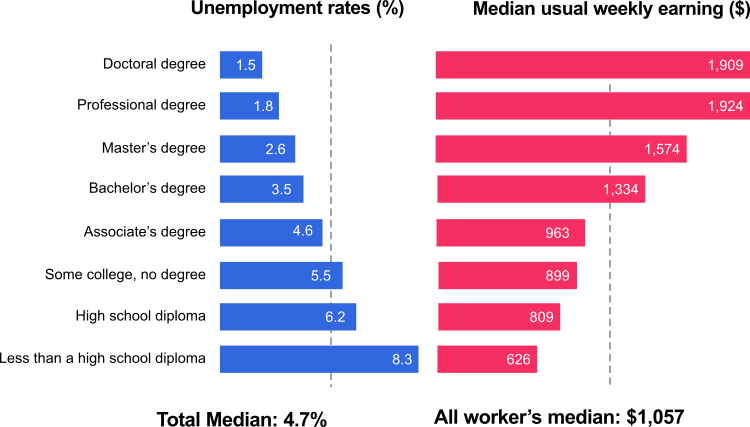
Evidence from numerous studies indicates that educational attainment is related to income, money earned on a regular basis through work (C-19), so you just gathered another clue (Jacobson and Mokher 2009; Fogel 1966). It is socially unacceptable to ask people how much money they make, so we make inferences based on occupation and educational attainment
Residence
The fourth component of SES is where you live. Your zip code, neighborhood, and house/condo/apartment are indicators of your social class. Fort Worth, Texas, has a population of approximately 960,000, and if someone states they are from the north side or east side of the city, this is a clue as to their social class.
Information about an individual’s education, occupation, income, and residence accurately appraises even a stranger’s social class. With just two or three questions posed throughout a casual conversation, you can assess SES. It is noteworthy that men are more interested than women in “sizing someone up” regarding social class. Historically, American men have derived their social status and value based on their occupation and financial success, while women were more relational and focused on the home. Today, even with nearly 60 percent of women in the workforce, most working women still value relationships and fulfilling their roles within their families (U.S. Bureau of Labor Statistics 2021). You can test this social norm by listening to conversations between two men who introduce themselves to each other. Then do the same for two women making acquaintances. Deborah Tannen, a linguist at Georgetown University, states that men talk to determine and achieve status while women talk to determine and achieve connection (Tannen 1990). This gender difference is relevant to the importance of determining social class between men and women.
In summary, we most often use education, income, occupation, and residence to assess a person’s socioeconomic status. In addition to SES, other concepts are used to determine social class.
The German sociologist Max Weber (1864–1920) developed a social class theory that combined wealth, power, and prestige (Weber 2009). Wealth, the total of all personal assets, including property, investments, and income, was one criterion to determine social class. Weber argued that one does not have to be ultra-rich to be a member of the upper social class and obtain social status, as the other two criteria contribute significantly to the process. Power, the ability to exert control over others and achieve goals with or without the support of society, can garner social status as well. Politicians and clergy members may not be wealthy, but they can wield a tremendous amount of power in the community, which, in turn, confers social status. The third interrelated component is prestige, the level of esteem and respect afforded to an individual often associated with one’s occupation or membership in a group or organization. Periodically, national polls are administered in the U.S. to determine which occupation has the highest occupational prestige. Table 8.1.1 provides the top 10 occupations with the highest occupational prestige, a consensus of the value of a job or profession (C-19). A survey asked, “Below is a list of occupations. For each, how, if at all, prestigious do you find the occupation?” The results of the survey are listed below. Many occupations in the 2016 Harris Poll have an associated level of high status but not necessarily a high salary. Are there occupations that you would have put in the Top 10 instead? Is your future occupation listed?
This is a reality.
The Inequality of Social Stratification
Why does social inequality, a system that unequally rewards individuals based on characteristics such as sex, income, age, race, and ethnicity (HP), exist in the U.S. and around the world? It is a fair question when you consider that the U.S. CEO-to-median worker compensation was 20:1 in 1965, increased to 287:1 in 2018, and 351:1 in 2020 (Mishel and Kandra 2021; AFL-CIO 2019; Chamberlain 2015; Mishel and Davis 2014). In 2019, women made an average of 82 percent of the median earnings of male full-time workers (Semega et al. 2020). In the U.S., the average African American and Hispanic households own only nine cents, respectively, for every dollar in wealth held by the typical white family (American Sociological Association 2019). More than 13 million of 74 million kids in the U.S. live in poverty, one of the highest poverty rates in economically developed countries (Annie E. Casey Foundation 2019; U.S. Census Bureau 2018b; OECD Family Database: Child Poverty 2014).
In 2021, The State of Food Insecurity in the World estimated that between 702 and 828 million people of the 7.8 billion global population suffered from chronic hunger and insufficient food to live actively (Food and Agricultural Organization of the United Nations 2022). What structural issues prevent this boy (photo) from eating enough food to conduct a normal and active life?
Is it possible to reduce social inequality? Why does it exist in the first place? Sociologists answer this question by pointing out that social structures perpetuate inequalities and maintain social stratification in societies. Social structures, those distinctive and stable arrangements of social patterns that form the society, are slow to evolve and challenging to alter. Regarding the earlier examples of inequalities, is it the U.S. government and corporations’ responsibility to alter existing social structures? Should the government enforce equal pay for women? How can governments and international organizations work together to address global poverty and food insecurities? Are these structural problems too big to resolve? History demonstrates that social structures have changed in areas such as women’s right to vote, the Civil Rights movements, anti-apartheid in South Africa, and same-sex marriages in the U.S. Social, political, economic, and technological changes all contribute to alterations in social structures.
Systems of Stratification
upper class, a category of people who maintain the highest status and resources in a society (HP), is the only segment of society experiencing significant household income growth. In 2018, 19 percent of U.S. households comprised the upper class (C-19) (Fry and Kochhar 2018). The top 1 percent of household incomes in 2019 was an average of $421,347, although the amount varies by state. In New Mexico, it only requires $256,168 (lowest of all 50 states) to be in the top 1 percent, but a salary of $663,009 is needed to be in the top 1 percent in Connecticut (highest) (Suneson 2019). San Francisco is ranked #1 worldwide for the highest salaries and disposable income after rent, followed by Zurich, Switzerland, New York, Boston, and Chicago (Curran 2019).
and sports businesses are first-generation millionaires and billionaires and differ culturally and socially from those listed in the Social Register, a directory of American families who form the “old money” social elite.
The six wealthiest Americans are worth more than the Gross Domestic Product (GDP) of 13 states combined, and the 50 richest Americans now hold almost as much wealth as half of the U.S. (Dean 2021; Steverman and Tanzi 2020). The share of wealth among the wealthiest 1 percent increased from 23 percent in 1989 to 32 percent in 2018 (Federal Reserve Board 2019). To put this into perspective, the entire middle class now holds less wealth than the top 1 percent of Americans.
The middle class, the category of people at the center of a social hierarchy, comprises most American households (52 percent). The range is sometimes calculated as 67 percent to 200 percent of the median income, which would be $43,168–$128,860 in 2019. This wide range reflects tremendous diversity in the middle class regarding educational attainment, culture, and hobbies, disallowing generalizations about this social class. A plumber, college professor, and professional bass fisherman will likely fall in the middle class and have varied interests.
The most important aspect of the middle class is that it has been shrinking, stagnating, and becoming less secure. In 1971, 61 percent of Americans were middle class compared to 52 percent today. Rising costs of education, healthcare, housing, technology changes, and global competition are reasons for the middle class’s demise. One in six middle-class workers will likely lose their job due to automation, and 20 percent of middle-class households borrow money to make ends meet (OECD 2019). Although hourly wages have increased since 1964, the purchasing power has not increased significantly. Figure 8.2.4 displays that the purchasing power in 1964 dollars was $20.27 and has only increased to $22.65 by 2018. This demonstrates that middle-class workers’ purchasing power is stagnant, putting them at risk for downward mobility.
The lower class, the lowest category of people in a social hierarchy (HP), struggles to meet their daily needs and often is in debt. This class is over-represented by minorities, women, and children and comprises 29 percent of households. The Federal Poverty Line (FPL), a governmental standard of measurement indicating the income level of when an individual or family is designated as poor, for a family of four in 2021, is $26,500. An individual making less than $12,490 is considered to fall into this category (U.S. Department of Health and Human Services 2021). It’s a myth that most individuals who make up the lower class are lazy and don’t want to work. The working poor, individuals who spend more than 27 weeks per year in the paid labor force and live below the poverty line, often work full-time but are paid low wages and do not receive benefits such as health insurance, retirement plans, and vacations. People who serve food, care for the young and elderly, and clean offices and hotel rooms are likely to qualify as the working poor and experience poverty. The next module will provide more insight into the social problems associated with poverty.
Problems of Stratification
The poverty rate, the percentage of people who are considered poor (HP), was 13.7 percent in 2021, with Whites at 9.6 percent, Blacks at 18.1 percent, and Hispanics at 21.9 percent (Urban Institute 2021). Poverty was first measured in 1959 when 22.4 percent of individuals lived in poverty. Of the 328 million Americans in 2021, this adds up to about one in seven living below the poverty line (Fontenot, Semega, and Kollar 2018). It is difficult for these households to escape poverty due to structural factors. This inescapable nature reinforces French sociologist Pierre Bourdieu’s (1930–2002) concept of social reproduction, the process of children remaining in the same social class through intergenerational transmission of various types of capital. How has your family contributed to the social reproduction of your social class through the transmission of cultural capital and social values and norms? Can you trace your family history to determine if your family’s social class has changed over the past three generations?
Unemployment, an expensive medical bill, a car repair expense, or weather-related disasters can severely disrupt the living conditions of a family living paycheck to paycheck. When a culture of poverty is established, structural patterns make it difficult to change the beliefs, values, and norms associated with the social conditions and accepted by the individuals. The result is the perpetuation of poverty from one generation to the next, although structural conditions can occur to better the conditions of families living in poverty. The historic low for the poverty rate was 11 percent in 1973, and the decrease was partially related to the 1971 Food Stamp Act that made food stamps more accessible. Public policy can play a role in reducing the rate of poverty as well as increasing it. In 1983, as a result of President Nixon cutting $20 billion from the food stamp and welfare programs, poverty rose in the United States (Timeline of Federal Actions Affecting Poverty 2012).
Notice that fewer Americans are living in poverty in 2021 compared to 1959. This indicates progress since the population in 1959 was 117 million compared to 332 million in 2021. The poverty rate dropped from approximately 24 percent to 12 percent — a significant reduction in the U.S. In the next learning objective, we will focus on the global poverty rate.
Global Poverty
Why are some countries poor and others wealthy? How do we explain how many countries have remained impoverished while others have flourished? The answers to both questions are complex but are mainly due to structural issues within and between the countries.
The Modernization Theory
The modernization theory, a macro theory indicating the process by which nations progress through stages of development, provides an explanation for why some countries are poor and others are wealthy. This theory posits that nations undergo social evolutions consisting of specific social variables contributing to social progress and development. The changes in Western European and North American countries since the 1700s provide insight into the social, political, and cultural consequences of economic growth during this period. The adoption of industrial technologies is essential for countries to modernize. Other variables include urbanization, health care, mass media, and transportation. When there are structural obstacles that hinder the introduction of these variables, modernization is slowed. A prime example is North Korea and South Korea.
The second explanation is the dependency theory, a macro theory indicating the stratified world economic system keeps peripheral nations dependent on core nations. It emphasizes three categories of countries: core, semi-periphery, and periphery.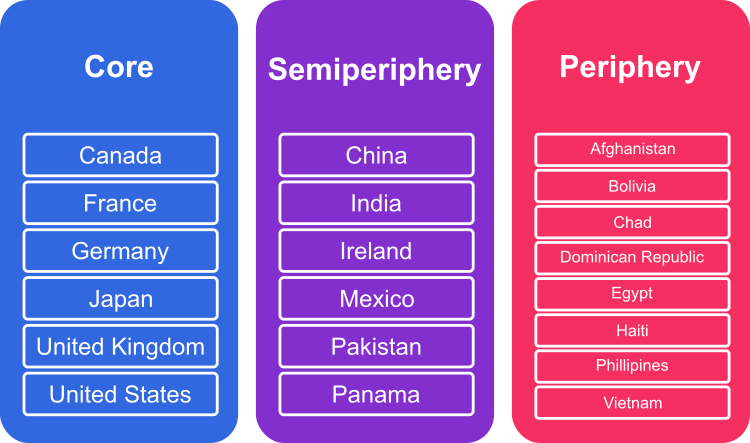
Immanuel Wallerstein’s (1930–2019) theory reflects the conflict theory approach, as he introduces the concept of a world-system, any historical social system of interdependent parts that form a bonded structure and operate according to distinct rules (Wallerstein 1974). He defines core nations as the wealthy and powerful industrialized nations such as the U.S., Japan, and Germany. The periphery nations have weak governments and are the least industrialized and economically diverse. The core nations are able to exploit the periphery nations for their resources and take economic advantage of developing countries such as Nicaragua, the Philippines, and Jamaica.
In many ways, sustainability is closely aligned with addressing the inequalities between countries. For centuries, core countries colonized and exploited the periphery countries for their natural and human resources. Sustainability focuses on the environmental, social, and economic injustices that have severely hindered the periphery countries from developing and progressing toward becoming semi-periphery or core nations. Historically, many European countries and the U.S. have exploited these countries for their cheap labor and extracted their natural resources with the primary goal of financial benefit over the well-being of the citizens and their country. Today, multinational corporations champion corporate responsibility and sustainable practices considering the triple bottom line — people, profit, and the planet. Coca-Cola is empowering five million women by 2020 through offering entrepreneurial programs, developing water stewardship programs and pledging to replenish water extracted by their manufacturing process in drought-stricken areas, and delivering supplies and education to aid in Ebola prevention in African countries. Coca-Cola is working to ensure all workers are treated with dignity and respect in every country where they do business. They are also researching and developing new technologies to grow their business without increasing greenhouse gas emissions. These initiatives work toward improving the environment and the social and economic lives of the people living in the 200+ countries where Coca-Cola operates daily
Inequality in Society
Social stratification often fosters the unequal distribution of benefits, opportunities, and rewards based on one’s class position within society. Social stratification is at the core of inequality:
- Class inequality
- Race inequality
- Gender inequality
- Educational inequality
The problem is that there is a huge difference between trying to live off of $25,000 compared to $120,000. For people on the lower end of the spectrum struggling to afford the basic necessities of food, shelter, and clothing, those in the middle would appear to be rich. Yet, those in the upper range of the middle class do not see themselves as well off compared to the rich in society.
Regardless of where people fall on the economic spectrum, the reality is that there is a significant difference between what people think they need to feel wealthy and the amount of money the truly wealthy have. Known as the wealth gap, it refers to the uneven distribution of financial assets and resources in a society that results from the concentration of money in the hands of a small segment of the population. While people on the low end of the wealth gap, i.e., the middle class, have an idea of what it means to be rich, as the image carousel points out, the super-rich have wealth well beyond what the middle class can even imagine. Hover your mouse over the images to learn more.
tihad Airlines offers its customers a private VIP three-room cabin that accommodates two travelers for a one-way transatlantic flight for $29,000. With a living room, separate bedroom, and ensuite shower room, it is the only three-room suite on a commercial airline (Etihad 2019).
A Bugatti Chiron sports car has an estimated top speed of 288 miles per hour and a base sticker price of $3 million. A set of tires for the Chiron cost $42,000. If you order it today, you get it in three years (Car and Driver 2019).
The Chartwell Estate in Los Angeles was initially listed for $245 million and was sold to Rupert Murdoch’s son, Lachlan, for $150 million in 2019. It has 11 bedrooms, 18 bathrooms, and a ballroom. At the selling price, it seems like it was a real steal, even if the annual property taxes are $1.3 million (Warren and Brandt 2019)!
Those who can afford expensive yachts or million-dollar cars are often called the “.01 percent in society.” Does it shock you that the world’s 26 richest billionaires own as many assets as the 3.8 billion people who comprise the poorest half of the planet’s population (Oxfam 2019)?
This uneven distribution of wealth is by no means a sudden development; it indicates that economic growth has been concentrated in the hands of a few instead of distributed among the many. Since the 2008 financial crisis, 60 percent of economic gains in the past decade have gone to the top 1 percent (Pressman 2019). Meanwhile, wages for all but the wealthy have remained stagnant for the past four decades. The result is that the middle class has accumulated bills and debt to stay afloat and is left with little or no savings. When the COVID-19 pandemic hit, many in the middle class did not have a full safety net, even with stimulus checks, child tax credit payments, eviction bans, and foreclosure moratoriums. While inequality and hardship increased for middle-class members during the pandemic, the wealthiest Americans became wealthier, further highlighting the uneven distribution of wealth in America.
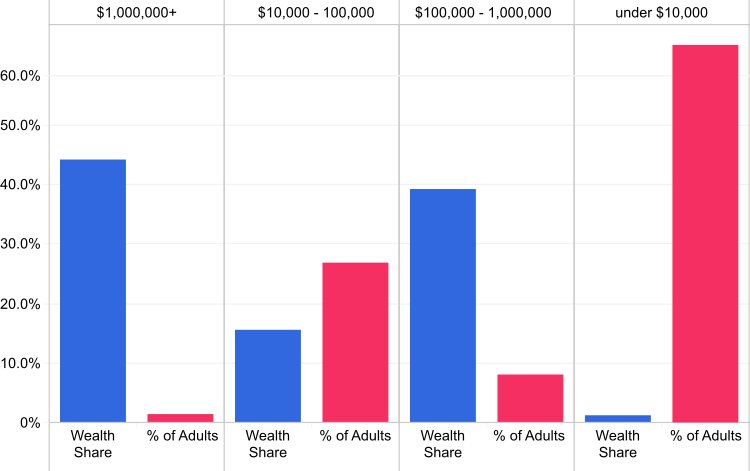
Class inequality is not unique to the United States. The concentration of wealth in the hands of the few can be found worldwide. Figure 8.3.3 illustrates the share of global wealth. The richest 1 percent own 45 percent of the world’s wealth, and adults with less than $10,000 in wealth comprise 64 percent of the world’s population but hold less than 2 percent of global wealth.
Economic inequality has not gone unnoticed by members of societies around the world. For a brief period starting in 2011, issues of economic inequality were front and center due to thousands of people taking to the streets in what was called the Occupy Wall Street protest. Hover your mouse over the images below to see a chronicle of the events.
The problem of racial inequality is not new. American society has historically been divided along racial and ethnic lines, with those on the top being White and those on the bottom being everybody else.
Inequality also extends along gender lines, and with gender, there is inequality between the races. Overall, women earned 81 cents for every dollar a man made in 2018. When broken down by race, White American women earned 81.5 percent of what White men earned. By comparison, Asian women earned 75.5 percent of what Asian men earned, Black women earned 89 percent, and Hispanics earned 85.7 percent of what men in their racial category earned (Institute for Women’s Policy Research 2019). The stark reality is that the men in these racial groups earn less than White men doing similar work. Figure 8.3.5 gives us a much more accurate picture of how men’s and women’s salaries fare compared by race and ethnicity from 2000 to 2022.
The implication of wage inequality is not only that women have less money to spend on groceries or a cell phone bill, but since 41 percent of American women are the primary source of support for their families, it extends to the ability to support their loved ones (Glynn 2019). Pay inequality also impacts women’s long-term living needs. A woman making 79 percent of her male counterpart has less money to put towards her retirement than a man does; that makes her more vulnerable to turning to extended family, social services, or the government for assistance. Given that, on average, women live longer than men, the big picture is that they work just as hard as men, makes less money than man, have less money to save than men, and will have less to live off in their senior years.
Since 1997, there has been an attempt to correct gender inequality in the workplace with the Paycheck Fairness Act, a piece of legislation that would:
- prohibit employees from using salary history.
- protect against retaliation for discussing pay with colleagues.
- ensure equal pay for equal work.
- equalize discrimination claims based on gender, race, and ethnicity.
- support employers and employees to achieve fair pay practices (AAUW 2019).
The Paycheck Fairness Act has been introduced many times since 1997, but it has failed to pass both chambers of Congress. The U.S. House of Representatives passed the Act again in 2021, but it must go through the U.S. Senate before it becomes law (Smith 2021; Congress.gov 2019). Opponents of pay fairness for women argue that such legislation will make it harder for businesses to create jobs and that previous legislation should be enforced. For these reasons, the Democratic-backed bill is unlikely to see movement in the Republican-controlled Senate. Supporters of pay fairness contend that the fundamental issue is fairness for those currently employed and that those other pieces of legislation do not adequately address economic inequality. If they did, women would not be making less than men (Bond 2014).
The statistics on pay inequality are the same for all women across the country.
This is a myth.
The third area of stratification that greatly impacts society is educational inequality. While access to education in America is a child’s right, the quality of that education can vary greatly depending on the student’s race and socioeconomic status. The difference that exists in student experiences manifests in the areas of teacher quality, academic output, and school discipline. Addressing those areas of concern, the Department of Education found:
- Black students are three times as likely as their White counterparts to attend schools where less than 60 percent of teachers meet state certification standards. Hispanic students are twice as likely to be in such schools.
- One-fourth of schools with high Black and Hispanic populations do not offer their students Algebra II, and one-third do not offer chemistry. Less than one-half of Native American students have access to any math and science courses typically offered in high school.
- Five percent of White students are expelled yearly from schools, compared to 16 percent of Black students. Native Americans represent less than 1 percent of the student population but experience 3 percent of the expulsions (Hsieh 2014).
The implications of educational inequality go beyond students’ immediate classroom experience and extend to long-term academic preparedness. Illustrating differences in college readiness, Table 8.3.3 shows the results of the Scholastic Aptitude Test or SAT review of student scores based on race and ethnicity.
When considered in the context of the big picture, the problem is that many minorities aren’t even in the earnings game and don’t have the opportunity to reach their full potential due to the educational deficits they experience in elementary, middle, and high school that keep them from moving on to college, let alone graduate or professional school. These educational deficits translate into real-world dollars and cents, and with less money, there is less to spend on housing, healthcare, retirement savings, or the education of the next generation of student learners.
The difference in earnings adds up significantly throughout a lifetime. A person with a professional degree can expect to earn upwards of $4.7 million over a lifetime. Doctoral and master’s degree earners make $4 million and $3.2 million, respectively. By comparison, Bachelor’s degree students earn, on average, $2.8 million throughout their lives, while people with a high school diploma earn approximately $1.6 million. An individual with a college degree will earn 75 percent more than a high school graduate over a lifetime (Carnevale, Cheah, and Wenzinger 2021).
With the issues of economic, racial, gender, and educational stratification in mind, take a moment to consider how sociological theory would address stratification in society.
The problems associated with stratification by income, race, gender, or education do not exist in a vacuum of independent variables but are interconnected with one impacting another and vice versa.
The American Dream
Private Troubles and Public Issues of Stratification
Success stories about the American dream are legendary. Most involve a person born into poverty working hard and eventually achieving untold wealth. Sociologists refer to the change from poverty to wealth as social mobility, an individual’s or group’s movement up or down the system of stratification in society. Since few people win the lottery and are suddenly catapulted into great wealth, a change in social position for most people results from having good life chances, the opportunities and resources a person has at their disposal to improve their quality of life (HP). A term first coined by Max Weber, life chances can include a range of factors that influence a person’s quality of life. From basics like food, shelter, and clothing to less tangible things like healthcare, education, and employment, life chances can vary dramatically between societies.
| Life Chances | Countries |
|---|---|
| Best places to be born | Switzerland, Australia, Norway, Sweden, Denmark, Singapore, New Zealand, Netherlands, Canada, and Hong Kong |
| Worst places to be born | Azerbaijan, Indonesia, Russia, Syria, Kazakhstan, Pakistan, Angola, Bangladesh, Ukraine, Kenya, and Nigeria |
| Countries with the best quality food | Netherlands, France, Switzerland, Denmark, Sweden, Austria, Belgium, Ireland, Italy, Portugal, Luxembourg, and Australia |
| Countries with the worst quality food | Yemen, Madagascar, Ethiopia, Angola, and Chad |
| The best healthcare in the world | United Kingdom, Switzerland, Sweden, Australia, Germany, Netherlands, New Zealand & Norway, France, and Canada |
| The worst healthcare in the world | Zambia, Lesotho, Mozambique, Malawi, Liberia, Nigeria, Democratic Republic of Congo, Central African Republic, Myanmar, and Sierra Leone |
| Places with the best educational systems | South Korea, Japan, Singapore, Hong Kong, Finland, United Kingdom, Canada, Netherlands, Ireland, and Poland |
| Places with the worst educational systems | Angola, Gambia, Pakistan, Guinea, Eritrea, Ethiopia, Central African Republic, Mali, Burkina Faso, and Niger |
| Countries with the highest standard of living | Australia, Sweden, Canada, Norway, Switzerland, United States, Denmark, Netherlands, Iceland, and the United Kingdom |
| Countries with the lowest standard of living | Guinea, Niger, Mali, Sierra Leone, Guinea-Bissau, and Burkina Faso |
Life chances also vary in a society. As we have already seen, in the United States, a person with a college education has higher life chances due to their potential to earn a higher income, which acts as a gateway to better healthcare, a better home, and greater opportunities overall. An individual’s cultural and social capital greatly enhance their life chances. The concept of cultural capital, the information, knowledge, and ideas people use to support their social mobility, was first introduced by Pierre Bourdieu. The range of items that fall under the rubric of cultural capital varies across time, place, and culture, but in a work setting, it can include everything from how to shake hands properly, dress for an interview, or what tone of voice to use in an office setting. Social capital, the social networks that people can use to enhance their societal position, may include things like business associations, clubs, sororities, fraternities, etc., all of which may be used to enhance their members’ social and or economic position.
The concepts of cultural and social capital bring into stark focus the personal troubles vs. public issues aspect of stratification. While the larger society is often focused on macro stratification issues such as education or jobs, the role of personal or micro-level concepts such as cultural and social capital cannot be underestimated when considering a person’s success. Even if society has addressed the public issue of job availability, if people do not know how to dress for an interview or don’t have social connections to put in a good word to potential employers, the question of their employment becomes a personal trouble, not necessarily a public issue for the larger society to address.
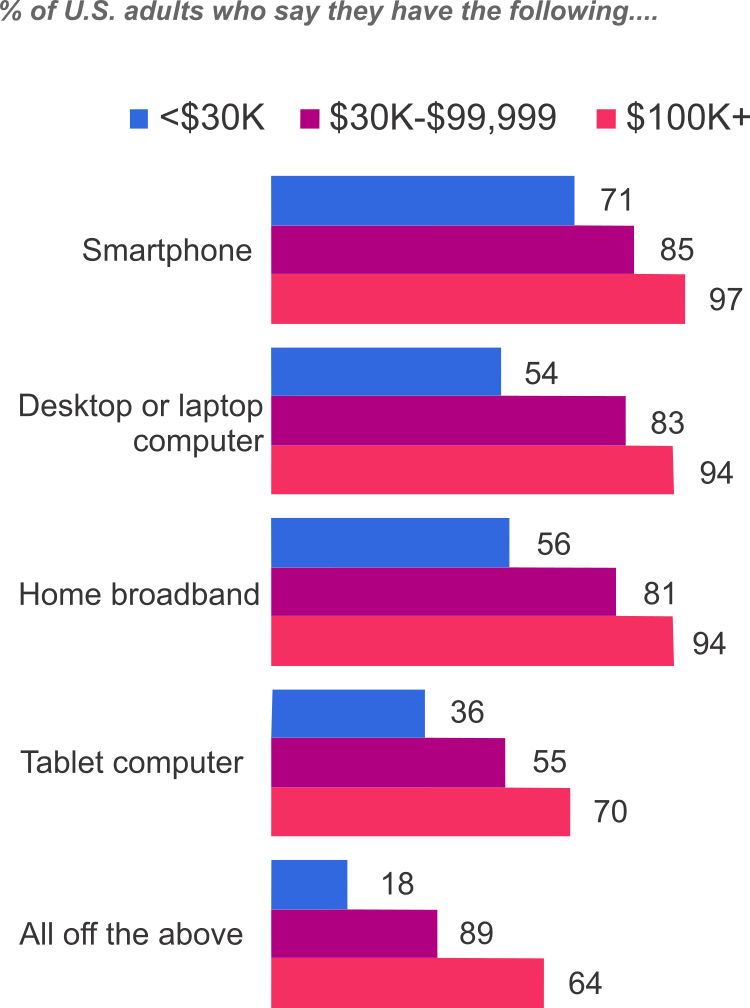
Another aspect of life chances that is particularly important to those living in Western society is the digital divide, the access to and ability to use technology like computers and the Internet. In the 21st century, being computer illiterate or not having internet access puts a person at a great disadvantage personally and professionally. From engaging in general correspondence to looking for jobs online or participating in electronic voting, computers permeate our world. Those without computer knowledge or access are severely hampered. Figure 8.4.1 indicates that lower-income U.S. adults have lower technology adoption levels than adults making more than $100,000. Only 18 percent of the individuals surveyed making less than $30,000 had all the forms of technology compared to 39 percent and 64 percent for the other two income ranges.
The economic problems associated with the digital divide are far-reaching. The lack of access to technology speaks to an individual’s or family’s ability to afford a computer or Internet access in the home. Similarly, a nation’s ability to implement technology is greatly influenced by society’s degree of wealth. Without access to technology, the individual is at a disadvantage educationally, professionally, and socially. A nation that offers its citizens little to no access to technology is severely limited in its ability to compete in the global marketplace. In the area of stratification, the digital divide is both a personal trouble and a public issue.
The Ups and Downs of Stratification
in an open system of stratification, a change in one’s social position can occur in various ways. An individual, family, or group can move up, down, or across the system of stratification in what sociologists identify as either vertical or horizontal mobility. Vertical mobility, movement up or down the system of stratification (HP), typically occurs due to a change in status that results in increased income from a job or improved social position due to marriage. A few individuals in Western society may even experience vertical mobility because they won a large sum of money through the lottery. By comparison, downward movement may occur due to a job loss, divorce, or even losing money in the stock market. Horizontal mobility, movement within a layer of the system of stratification, can be seen when an individual changes employment in a way that does not increase income or social position, such as a history teacher leaving one school district to teach the same subject in another district.
the social mobility individuals experience can be further categorized depending on whether mobility is intragenerational or intergenerational. An example of intragenerational mobility, an individual’s change in status during a lifetime, is when an individual starts as a history teacher, decides to move into administration, and eventually becomes the school district superintendent. Using our history teacher analogy, intergenerational mobility, an individual’s change in social status that results from mobility on a generational level, is when that individual was the first person in his family to graduate from college, his status as a history teacher was significantly different from family members in a previous generation. Being the first in a family to graduate from college increases the possibility of intergenerational mobility. How have members of your family experienced vertical, intragenerational, and intergenerational mobility?
The examples above of social mobility are often associated with the efforts of the individual. The history teacher had to attend classes, study, and work hard to change his social position. If he experienced difficulty studying or chose not to work hard, we would say that his lack of success was a personal trouble. Sometimes though, social mobility is outside the individual’s effort and in the realm of public issues. The recession of 2008 and the subsequent economic losses that impacted large swaths of the middle and working class were outside individuals’ control; they were a failure of the global financial sector. This is referred to as structural mobility, changes in the social position of a group that result from shifts in the larger society (HP). Structural mobility is a form of vertical mobility in which segments of the society move up or down the system of stratification. Another example would be a change in the immigration pattern in a society that results in new groups entering at the bottom of the social hierarchy, thus causing previously established communities to shift up the system of stratification.
These various forms of mobility speak to the larger issue of opportunity and inequality in stratification systems. Social inequality is inherent to stratification. The most effective way for individuals or groups to improve their access to better education, employment, healthcare, and housing is by using forms of mobility to move up the social structure. Yet, as we shall see, the ability to use social mobility to improve an individual’s position in society can be greatly influenced by biological sex.