
Notes:
Sex and Gender
The terms sex, sexuality, and gender are often used interchangeably and sometimes incorrectly in conversations, reports, and interviews.
| Sex | Biological and anatomical variances between males and females |
| Sexuality | An individual’s experience and expression as a sexual being |
| Gender | The socially learned expectations and behaviors associated with being a man or woman |
The concept of male and female is part of a traditional system known as binary, the belief that there are only two distinct and opposite categories. More recently, society has begun to acknowledge that sex is less a function of two distinct extremes of male and female but more of a spectrum between those two extremes.

Masculinity and Femininity
In the gender identity and gender expression spectrums are people who identify as nonbinary, fluid, genderqueer, or gender nonconforming, an individual whose behavior and/or gender expression do not conform to society’s norms for masculine and feminine. In 2019, Grammy Award-winning singer Sam Smith came out as gender nonconforming, and in 2021, 23-year-old Owen Hurcum became the first known nonbinary mayor of Bangor, Wales (Aviles 2019; Yurcaba 2021). As you’ll see throughout the chapter, individuals have different ways of expressing their gender identity.
We know now that gender refers to the socially learned expectations and behaviors associated with being male or female. Two of the socially learned expectations and behaviors, masculinity, traditional behaviors and traits associated with men (HP), and femininity, traditional behaviors, and traits associated with women, are learned behaviors as a result of the socialization process. Both concepts are central to understanding gender. You did not have to ask your parents, consult a textbook, or watch television to understand the expectations of being a male or female. If you are a male, you were likely encouraged to demonstrate masculine traits through the toys you played with and sports participation. If you are a female, you may have been socialized based on perceived feminine qualities by dancing or playing with tea sets and dolls.
These scripts have been indelibly inked into society and rehearsed for centuries, although these scripts and roles have slowly changed over the past century. Recently, gender-neutral products have been popping up everywhere. In 2019, H&M stores launched a gender-neutral clothing line in collaboration with the Swedish label Eytys (Young 2019). Lululemon offers gender-neutral self-care products, and Nike released a gender-neutral collection of clothes marketed as comfortable and iconic looks without gender distinctions. Although gender-neutral, non-binary, and genderless products are gaining popularity, traditional gender-specific products and roles are unlikely to go out of style.
Harvard University sociologist Talcott Parsons (1902–1979) described the traditional roles for males and females in the family as expressive and instrumental. The feminine-expressive role, providing care and emotional support, has traditionally been the role of the wife and mother. In contrast, the masculine-instrumental role, goal-oriented and providing financial support, has been the role of the husband and father (Parsons and Bales 1955). Sixty years ago, when these concepts were developed, most men and women fulfilled these roles. Today, these roles are not so clear-cut, which demonstrates how the socially learned expectations and roles of gender are changing in the U.S.
The socialization of gender is a constant process, and you probably are not conscious of the process until you reach adolescence or adulthood. Throughout childhood, you most likely accepted the social cues and roles that reinforce what it means to be a boy or girl. As a visible demonstration of your acceptance of these roles, you developed acceptable levels of masculinity and femininity in your life.
As individuality increases in the U.S., you can expect to see more departures from traditional gender norms. It has become more socially acceptable for men to display feminine traits and for women to express masculine traits without fear of being socially sanctioned or shunned.
The Social Construction of Gender
Developing and influencing a child’s gender identity, an individual’s inner sense, and identification of being masculine or feminine, begins even before birth as parents choose colors for the baby’s room — traditionally blue for boys and pink for girls. Fathers may wrestle with their sons and have tea parties with their daughters. Boys are pushed toward math and science, and girls receive less encouragement and praise to pursue these subjects. Women tend to be employed in occupations such as administrative assistants, nurses, elementary school teachers, cashiers, retail salespersons, and waitresses, while men enter the business and financial sectors, welding, plumbing, construction, computer and mathematical, and engineering and architectural occupational groups (Women’s Bureau 2010)
| Gender Nonconformity | An individual whose behavior and/or gender expression does not conform to society’s norms for masculine and feminine. |
| Genderqueer | A person whose gender expression and/or identity is neither masculine nor feminine. Genderqueer is sometimes used synonymously with non-binary or gender fluid. |
| Cisgender | An individual whose gender identity matches their sex at birth. |
| Transgender | A person who identifies with a gender that is different from their biological sex. |
Gender Norms and Roles
These expectations are reinforced through gender norms, behaviors, or traits that society attributes to a particular sex (HP). Boys are supposed to play football, and girls play with dolls. What happens when a male or female deviates from the expected gender roles? It is expected that males are “supposed” to be more aggressive than females, and this norm is reinforced by football being an all-male sport. Becca Longo, a student at Adams State in Colorado, deviated from this expected norm in 2017 by being the first woman kicker to earn a football scholarship to a Division I or II school (Anderson 2017). Can’t you hear it now, “C’mon Longo, you’re not supposed to play football. It’s for guys!” Vanderbilt kicker Sarah Fuller became the first woman to score in a Power 5 game in 2020 (ESPN News Services 2020).
In 2013, actor Will Smith’s son, Jaden Smith, began to publicly defy gender norms by wearing dresses, skirts, and heels in photos and to major events. In 2016, Louis Vuitton featured Jaden as the face of their new womenswear line. In 2018, he tweeted, “If I Wanna Wear a Dress, Then I Will.” Other celebrities who deviate from traditional gender norms include singer Harry Styles and actor, singer, and author Billy Porter (Nardino 2021). Can you think of other examples?
As a child, you developed your gender identity primarily through social interactions with your parents, teachers, and peers. Parents generally do not encourage their daughters to participate in little league football, and coaches do not recruit girls in high school to suit up in pads and a helmet. Traditional female gender roles, public expression of one’s gender identity, include displaying feminine qualities such as a focus on interpersonal relationships. Male gender roles rest on masculine qualities, such as aggressive behaviors. Becca Longo’s association with the football team was a departure from the expected gender roles of a female college student. Why is she the first female scholarship recipient in college football? The concept of doing gender will shed some light on this question.
Doing Gender
Gender is socially constructed through our everyday social interactions. Sociologists West and Zimmerman (1987) termed this process doing gender. You learn scripts about what is appropriate, and you perform based on gender norms. Following are the basic components of doing gender (HP).
- Gender is not only related to what a person is but what a person does in social interactions.
- We do gender knowing others will judge our performance, especially if we do gender outside the normative gender scripts.
- Children are taught from an early age about doing gender and monitoring their own behavior and their peers to ensure their behavior is gender appropriate.
As a child, you learned to do gender, which reinforced the societal gender norms. Young girls are doing gender by playing with dolls, choosing to be passive, and wearing dress-up high heels. Boys are doing gender when they get into friendly wrestling matches, focus more on sports than homework, and display a rebellious attitude. As an adult, you will most likely continue the process of doing gender even if you decide to challenge the gender status quo. Most individuals opt for conformity, as shown in the following example of greetings. Both Jaden Smith and Becca Longo challenged the status quo and experienced negative feedback from segments of the population and positive feedback from others, illustrating the distinction between attempts to maintain traditional gender roles and progressive movements in redefining gender and gender identity.
The majority of individuals conform to society’s gender norms and roles. When two men greet each other in the U.S., a handshake is appropriate in most situations. In Argentina, when two men meet, it is common to greet each other with a kiss on each cheek. Chilean men hug when greeting, while American men might feel awkward greeting another man with a hug. Greetings can be extremely different across cultures, which suggests the extent to which gender norms are socially constructed. The development of gender norms in a society is a social process. Males are taught or observe others to determine whether to shake, kiss, or hug when greeting one another. Regardless of your gender, you have observed the gender scripts regarding greetings and, in most cases, conformed to the expectations to avoid being ridiculed.
Applying the concept of the social construction of gender to your own life is a fun exercise. Think about how you were socialized regarding gender. Do you have photos of how your room was decorated when you were born? Was your room pink, blue, or yellow? What kind of toys were you given to play with as a child? Dolls? Balls? Did your parents encourage you to join a sports team? Participate in dance? What gender roles did your kindergarten teacher emphasize? How did your elementary classmates unknowingly reinforce the gender roles for males and females? Do you remember peers who did not adhere to the typical gender roles? Were they ridiculed or encouraged to conform? At what age did you become aware of consciously making your own decisions about doing gender?
These questions reinforce the socialization process by which your gender identity was socially constructed long before you could make your own choices. This results from the social structures that influence the gender socialization process, many of which you may not be fully aware of during childhood, adolescence, and even possibly as a young adult.
Gender Socialization and Structural Issues
Numerous stable, structurally embedded arrangements in society contribute to gender socialization. Media, work, religion, politics, education, and the military all play a significant role in the gender socialization process. Specific types of media may promote sexism, prejudice, devaluation, and discrimination based on an individual’s sex (HP). Even though sexism is present, at times blatantly, you may not always recognize it in its subtler forms in all social institutions. Consider the depiction of the men and women in popular shows. In these shows, the female characters face some discrimination that many real-life women face every day. Similarly, male characters are stereotypically presented as overly masculine or inept.
Do the top-rated shows promote sexism? Critics of the now-classic comedy The Big Bang Theory accuse the show of “adorkable misogyny,” meaning the dorky and super-intelligent scientists got a free pass on making sexist comments. Others argued that Penny was portrayed as the “dumb blond” and “hot dumb girl” while Amy was characterized as a frumpy, cold, and masculine character, a sexist stereotype surrounding women in science. Are the sitcom writers sexist? Are they consciously and intentionally depicting the female characters stereotypically? Or are the writers just taking a snapshot of their social world, and sexism is a part of the landscape? We aren’t privy to the intentions and motivations of the writers, but the potential remains that The Big Bang Theory, as well as the other shows, are socializing millions of viewers with sexist perspectives and attitudes. If so, the media is contributing to the perpetuation of sexism on a structural level, and this form of gender socialization is impacting a large audience of viewers (23.44 million viewers watched the last episode of The Big Bang Theory on May 16, 2019).
As agents of socialization, both media and the family have impacted how you view males’ and females’ roles in society. Have you considered the subtle effects that media and your family have had on you regarding gender socialization? Let’s begin by exploring the impact of media.
Media
Consuming media such as TV, movies, and advertising occupies approximately a third of your day. How much does the media play a role in gender socialization for children, adolescents, and adults? Actress Geena Davis pondered this question after her first child was born in 2002. As her child grew and started watching family films, Davis recognized the need for gender balance in this genre, as there is, on average, one female character for every three male characters. She established the Institute on Gender in Media to conduct research, reduce stereotyping of females in films, and create a wide variety of female characters for entertainment targeting children 11 and under. Davis understands the power of media in molding and shaping children. She states, “If she can see it… she can be it.” By researching the film and entertainment industry, she hopes to influence the industry to increase positive images of girls and women in films so there will be more females to serve as role models (Geena Davis Institute on Gender in Media 2019).
Media can set standards and reinforce many aspects of American life. Media influences gender roles and identity through its depiction of male and female characters.
Male characters are typically portrayed in the media as
- active, powerful, and adventurous
- sexually aggressive
- largely uninvolved in human relationships
Females characters are typically portrayed in media as
- young, thin, and beautiful
- passive, dependent, and often incompetent
- devoted to improving their appearance
As a result of these distortions and the pervasiveness of media in our lives, these misrepresentations of gender may influence what is perceived as normal and desirable for women and men (Wood 1994). Magazines, video games, television, movies, and social media all contribute to gender stereotypes that are inaccurate and can even be harmful to individuals’ emotional, psychological, and physical well-being.
Research by Common Sense Media, a nonprofit organization that is a leading source of entertainment and technology recommendations for families and schools, shows that learning gender roles from movies and TV shows has real consequences on kids’ self-esteem, relationships, and future careers. The following are insights from Common Sense Media regarding how children aged two to six learn doing gender and recommendations on what parents can do to counteract stereotypes (Common Sense Media 2019; Knorr 2017).
At ages 2–6, kids
- learn their gender identities (that they’re a boy or a girl)
- learn stereotypes about activities, traits, toys, and skills associated with each gender
- begin gender-typed play (girls shop, dress up, and play “mom” with baby dolls while boys play racetrack cars, Legos, and sports)
- need to hear your input in specific, not abstract, terms
What you can do
- point out people from real life or TV that show more than one way to do gender
- comment positively on shows that equally value boys and girls
- find shows that aren’t hyper-pink or super-blue
Television and movies tremendously impact children’s formative years, just as print media can for teens and adults. Studies of female college students found that when exposed to the thin-ideal images of women in popular magazines, the students experienced increased body dissatisfaction, negative mood states, and decreased self-esteem (Posses 2013; Hawkins et al. 2004). The significance of these studies and many others is the correlation between these thin-ideal images and the estimated 20 million girls and women and 10 million boys and men in the United States who struggle with eating disorders (Eating Recovery Center 2019). In 2019, Nike introduced plus-size mannequins at their London flagship store to seemingly counterbalance the rake-thin models and mannequins that are promoted as normal (Thomas 2019). Typical female mannequins are six feet tall with 24-inch waists, which is not “normal” and would cause significant health issues for a woman in real life. The average American woman is closer to the plus-size mannequins’ size than the typical mannequin in stores. Nike’s decision to diversify mannequins’ size may be the start of developing a “new normal.\\\\\\\\\\\\\\\”
Supermodels Tyra Banks, Gigi Hadid, and Bella Hadid have publicly discussed their weight, body image, and self-esteem issues while working in the modeling industry, an environment causing negative body images among models. Why do you think models struggle with these issues? How has media impacted your gender socialization process?
In light of the above examples, it can be argued that media has been, and will continue to be, instrumental at a structural level in the process of gender socialization. Media’s gender misrepresentations and stereotypes are two examples of how you might be influenced regarding your gender identity and roles. As a mother, Geena Davis recognized the media’s potential impact on her daughter and family and took action. This is an important realization, as gender socialization is a family matter. The family is arguably the most influential agent of socialization regarding developing gender roles.
Family
We know that gender socialization begins before a baby is born and continues throughout the life course. Parents are the primary means of gender socialization. The transmission of gender-specific messages occurs by overt and covert means. Children then use this information to help construct categories, labels, and scripts about gender (Eckes and Trautner 2000). The following are examples from research regarding the parents’ influence on their children regarding what it means to be a boy or girl.
- Parents dress infants based on sex, provide sex-specific toys, and expect different behavior from boys and girls (Thorne 1993).
- Two-and-a-half-year-olds use gender stereotypes derived from parents to understand their world (Fagot, Leinbach, and O’Boyle 1992).
- Parents encourage their children to participate in sex-typed activities (Rocha 2005).
- Parents’ assignment of gender-specific chores links certain types of work with gender (Wood 2012).
Historically, a wife’s role was to take care of the household and children. During and after WWII, women entered the workforce in large numbers, with 57 percent of women working in February 2021, down from 59.2 percent in the pre-pandemic month of February 2020 (Rothwell and Saad 2021). The challenges women experience on the work front are often compounded by overwhelming responsibilities at home. These family and household tasks are known as the second shift, the unpaid childcare and household responsibilities completed by women that are in addition to their paid work in the labor force. As explained by the researcher Arlie Hochschild, women contribute to the financial well-being of the family but also shoulder the bulk of responsibility at home. While Hochschild calls this added responsibility a second shift, it can also be referred to as a double day
Whichever term is applied, the behavioral pattern is one in which both partners are employed outside the home, but only one of them is also responsible for taking care of the home after work. The second shift’s added responsibility can be tremendous, resulting in high levels of stress in heterosexual families because one person in the relationship (typically the wife) is perpetually overworked. Even though 70 percent of heterosexual women with children under the age of 18 work in the paid labor force, women are still disproportionately responsible for the domestic work in the family (U.S. Bureau of Labor Statistics 2022a). In heterosexual families, research has shown that 21 percent of men do household chores on an average day compared to 49 percent done by women (U.S. Bureau of Labor Statistics 2022b). While heterosexual husbands in the early 21st century are more involved in household tasks, their level of participation still pales compared to that of their wives. The transmission of gender roles from one generation to the next contributes to the continuation of the second shift. A 2019 Gallup poll found the division of labor in U.S. heterosexual households remains largely tilted toward traditional stereotypes, meaning women take care of the household and children and men take care of the yard and car (Brenan 2020). Children observe their mother working a double day, internalize these gender roles, and the pattern is repeated to some degree in their household if they marry and have children. In same-sex couples, research finds that there is great chore equality between the partners, with personal preference playing a key role in deciding who does what (Vleuten, Jaspers, and van der Lippe 2020). Interestingly, when young children are introduced into the relationship, same-sex couples, at least temporarily, gravitate toward more traditionally gendered divisions of labor, with one person having greater responsibility for day-to-day childcare while the other takes on the breadwinner role (Miller 2018)
illustrates, as the children grow, childcare responsibility among same-sex couples becomes more equal than that of different-sex couples.
How important do you think sharing household chores is to a successful marriage?

Thirty percent said it is “rather important,” and only 7 percent indicated it is “not very important.” Fifty years ago, your grandfather would have most likely answered “not very important,” and he would have been in the majority. This is just another example of how times have changed, as well as gender roles and expectations. Unfortunately, there are many issues related to gender that have not changed over time, such as gender stratification.
As traditional gender roles of mothers and fathers are shifting and new roles emerging, it will be interesting to follow the research to determine if children will adopt their parents’ new roles, such as stay-at-home dads. Stay-at-home dads are growing in number (17 percent of all stay-at-home parents), and their new role is considered by many to be an acceptable lifestyle choice in the family (Connley 2021; U.S. Census Bureau 2016; Williams 2012).
What is your image of an ideal family structure? If you both work, who will be responsible for the household chores such as cooking and cleaning? Most likely, your answers will reflect your ideas about gender roles.
Gender Stratification in the Workplace
Gender stratification, the unequal access and distribution of wealth, power, and privilege between women and men (HP), is structurally embedded in every society. The Global Gender Gap Index ranks countries that are leaders in dividing resources more equitably between women and men. The index considers structural characteristics in four key areas: access to healthcare, access to education, political participation, and economic equality. The 2021 report found that Iceland, Finland, Norway, New Zealand, Sweden, Namibia, and Rwanda are the most gender-equal countries. Overall, the gender gap is 68 percent, which means there is a 32 percent gap to close. On a positive note, progress is being made, but on its current trajectory, it will now take 135.6 years to close the gender gap worldwide. The United States ranked 30th of 156 countries in the survey (Gender Gap Index 2021).
Many countries, such as 43rd-ranked Uganda (see the red country in the map of Africa), address gender stratification with environmental sustainability as a central concern. The Bukonzo Joint Cooperative Micro Finance Society, Ltd. (Bukonzo Joint) is a 5,500+ producer/farmer, member-owned cooperative that sells Fair Trade and certified organic coffee internationally (Atlas Coffee Importers 2021; Sucafina Specialty 2021). Eighty-three percent of the Ugandan members are women. The co-op was established in 1999 to reduce gender inequality and poverty by successfully growing coffee with ecologically sustainable methods. Members have access to micro-financing services to develop a small coffee farm and sell their beans at higher prices through joint coffee marketing via the co-op. With surplus profits, the cooperative partnered with the government and built a community health center. The Bukonzo Joint is an example of how the environmental, economic, and social justice elements of sustainability have been successfully fused to address some of the structural barriers contributing to gender stratification in Uganda. Let’s turn our attention back to the U.S. and begin by examining structural characteristics responsible for the economic inequalities between men and women in the United States workplace.
The Wage Gap
Patriarchal systems have maintained traditional gender roles throughout most of history. Until the Industrial Revolution, most middle- to upper-class women did not work outside the home and were considered property in some societies. Today, even after 250 years in the workforce, women are still paid less than men and do not have the same advancement opportunities.
Lilly Ledbetter worked as a supervisor for the Goodyear Tire manufacturing company for 20 years. Ledbetter did the same job as her male counterparts and even received the company’s Top Performance Award (Pickert 2009). Unbeknownst to Ledbetter, she was paid $3,727 per month during the course of her employment, while other male supervisors earned $4,286 to $5,236 per month. After receiving an anonymous tip about the sizable pay inequity, Ledbetter filed a complaint with the Equal Employment Opportunity Commission or EEOC. In response to her complaint, Goodyear Tire assigned her, an older woman on the verge of retirement, the task of lifting heavy tires. Not surprisingly, Ledbetter saw this as an act of retaliation for her EEOC complaint and filed a lawsuit against Goodyear. While she initially won her lawsuit and a $3 million judgment, the amount was later reduced to $300,000 (Pickert 2009). Eventually, the case of Ledbetter v. Goodyear Tire and Rubber Co. made it to the U.S. Supreme Court, which ruled that Ledbetter was not entitled to back pay because she filed a lawsuit more than 180 days after she received her first unequal paycheck. The catch-22, of course, is that Goodyear kept their pay records confidential, so she didn’t know she was being paid less than male supervisors. How was she supposed to file a lawsuit against something she didn’t know about?
The Equal Pay Act (EPA) of 1963 was enacted to address issues of fair pay based on sex. As mentioned earlier, a continuous effort has been put behind passing the Paycheck Fairness Act, which would require employers to prove that gender is not the cause of salary inequality in situations where men and women are performing the same job (AAUW 2019). It would also give employees more rights when sharing salary information, which could have made quite a difference in Lilly Ledbetter’s career
Types of Discrimination at work
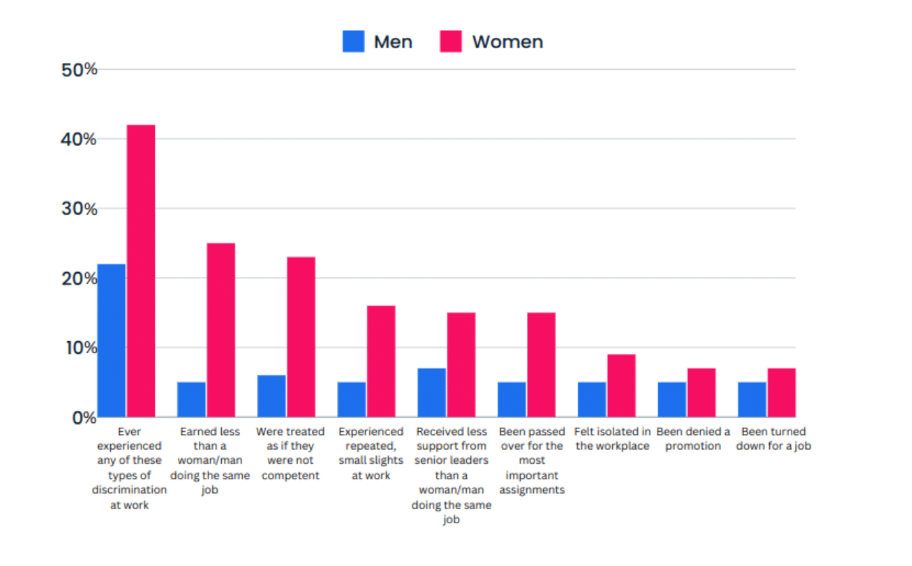
Lilly Ledbetter’s case is just the tip of the iceberg regarding the structural inequalities between men and women in the workplace. American women are paid, on average, 18 cents less for every dollar a man makes; that amounts to approximately $10,157 less per year and $406,280 over a 40-year career. For African American and Hispanic women, the financial losses over 40 years result in over $1 million less than White, non-Hispanic employed men (National Women’s Law Center 2020). In Utah, women make only 70 cents for every dollar a man makes (Utah Women & Leadership Project 2021). This inequality is true across industries and regardless of educational level.
Let’s consider the implications of the wage gap between men and women. A smaller salary means less money to feed your family, buy gas for your car, pay your bills, and set aside for your retirement or child’s college fund. While all of the implications of being paid less matter, the issue of retirement savings is huge over a lifetime. On average, women live five years longer than men (CDC 2018). The longer life expectancy, in combination with lower wages and less retirement money, creates the perfect storm whereby 16 percent of elderly women live in poverty compared to 12 percent of elderly men (Seegert 2019; Justice in Aging 2018). Along racial and ethnic lines, elderly African American and Hispanic women are twice as likely as their white counterparts to live in poverty. The implications of pay inequality are immediate and long-term, greatly influencing women’s quality of life in their senior years. Wages for women in the workforce today will not likely increase significantly in the near future, thus impacting their long-term financial outlook.
Since more women have undergraduate and graduate degrees than men, some men seek pink-collar jobs due to financial concerns, quality-of-life issues, and the gradual erosion of gender stereotypes (Dewan and Gebeloff 2012). As more men enter the pink-collar career fields, the wages will eventually increase for everyone, although the percentage of males is not large enough to raise women’s wages yet. As White males enter female-dominated professions, they will be promoted to supervisory positions over females. This process is known as the glass escalator, which means that men in female-dominated careers rise faster than women in male-dominated careers (HP). This will result in fewer opportunities for advancement and achieving high-ranking positions but an overall wage increase for women. Let’s further explore the roadblocks women meet regarding workplace advancement.
The Glass Ceiling
The wage gap is just one aspect related to gender that needs to be addressed to ensure equality in the workplace. Shattering the invisible glass ceiling, social and legal barriers designed to prevent minorities and women from advancing in the workplace (HP), would go a long way in opening avenues of opportunity and equality. Historically, researchers believed that minority men and non-minority women experienced the glass ceiling equally, but research by Cotter contends that women experience an even greater impact than minority men (Cotter et al. 2001). Of course, that leaves one to consider the experience of minority women. Arguably, given previously mentioned research that shows minority women earning substantially less than their White female counterparts, the glass ceiling is a structural barrier severely limiting their ability to advance and improve their economic situation. As Cotter explained, the specific parameters of the glass ceiling include the fact that any work-related behaviors of the employee cannot explain limitations in career advancement. An example might be a female worker doing everything she is supposed to do to advance in her career but continually being passed over for promotions in favor of her male colleagues. What needs to be changed on a structural level for more women to break through the glass ceiling?
Researchers now acknowledge that the glass ceiling also limits members of the Lesbian, Gay, Bisexual, Transgender, and Queer and Questioning (LGBTQ+) community. In these instances, the employee is limited from advancement because of the stigma associated with their sexual orientation or gender identity. A 2019 survey found that 53 percent of LGBTQ+ employees stated they have “experienced or witnessed anti-LGBTQ+ comments by co-workers” (Glassdoor 2019). Internationally, a negative media storm was created when the councilors of the small town of Krasnik, Poland, voted in 2019 to declare their town “free of L.G.B.T.” The decision has become a costly embarrassment jeopardizing millions of dollars in foreign funding. (Higgins 2021). This is an extreme case of structurally discriminating against the LGBTQ+ community. Sadly, there are similar types of structural discrimination and barriers experienced daily by marginalized groups of people in the corporate world.
Structural and Corporate Barriers
In 1991 President Bush commissioned the Federal Glass Ceiling Commission to identify the barriers that have blocked women and minorities’ advancement. The Commission concluded that there were structural and corporate barriers as follows:
Structural barriers related to gender
- unequal educational opportunities and attainment
- conscious and unconscious stereotyping, prejudice, and bias
- lack of vigorous, consistent government monitoring and law enforcement
Corporate barriers related to gender
- climates that alienate and isolate women
- special or different standards for performance evaluation
- counterproductive behavior and harassment by colleagues
(The Federal Glass Ceiling Commission 1995)
Although the government and corporations have addressed the above barriers, it is difficult to eliminate structural and corporate practices within corporate America. For example, eliminating “counterproductive behavior and harassment by colleagues” is impossible, as sexual harassment in its many forms is still widespread within the workplace.
Sexual Harassment
Sexual harassment, unwelcome sexual advances, requests for sexual favors, and other verbal and physical harassment of a sexual nature (HP), is one of the most discussed topics in employee relations today. It is divided into two types; quid pro quo, express or implied demands by an employer or supervisor for sexual favors in exchange for some benefit such as a promotion, raise, or preferential treatment (C-19), and a hostile environment, an intimidating, hostile, or offensive working environment due to unwelcome verbal or physical conduct of a sexual nature (U.S. Equal Employment Opportunity Commission 2012; Crucet et al. 2010).
The difficulty with determining sexual harassment is that there are many grey areas. Consider this scenario: After six months on the job at an advertising agency, a recent female college graduate experienced a co-worker constantly inquiring about her sex life and sexual history and pestering her for a date.
Does this seem to be a hostile environment? It most likely qualifies, as it meets the criteria that the harassment must be severe, pervasive, and reasonably offensive. What if a female supervisor constantly discusses the more graphic details of the erotic novel by British author E. L. James, 50 Shades of Grey, with a male coworker? Does this constitute a hostile environment? Both the glass ceiling and sexual harassment are difficult to assess and control. It is challenging to determine if a female is being overlooked for a promotion based on her sex or due to qualifications. When it comes to sexual harassment, women and men are often hesitant to report an incident for fear of reprisals.
Beginning in 2017, many women came forward to report sexual harassment as the Me Too movement catapulted onto the world stage after Alyssa Milano’s blog post encouraging others to use #MeToo to draw attention to sexual assault and harassment. It can be argued that this movement has done more to shed a powerful light on the aforementioned structural and corporate barriers and to empower women than decades of legislation have accomplished.
The wage gap, glass ceiling, sexual harassment, and structural and corporate barriers contribute to gender stratification. While all women are subject to gender stratification, it is not just gender that shapes their experiences of discrimination, marginalization, and oppression. The theory of intersectionality, the overlap of personal and social identities that manifests as disadvantage and discrimination in people’s lives, stresses that individuals experience multiple forms of inequities based on gender, race, ethnicity, social class, sexuality, citizenship, religion, age, and other dimensions of subordination.
Looking through the lens of intersectionality is critical for understanding the complexity and systemic nature of inequalities in women’s lives. This intersectional approach broadens the scope, helping us consider numerous other social identities contributing to gender stratification.
In the next learning objective, you will see further examples of gender stratification in religion and politics. Let’s discover why women experience a stained-glass ceiling in clergy roles and are underrepresented in politics
Gender Stratification in Religion and Politics
Religion, government, and politics are structural components of every society, and each influences how members view gender and how power structures are developed concerning gender. Religion serves many functions in society, and historically a central function has been to elevate the role of men and limit opportunities for women.
Politics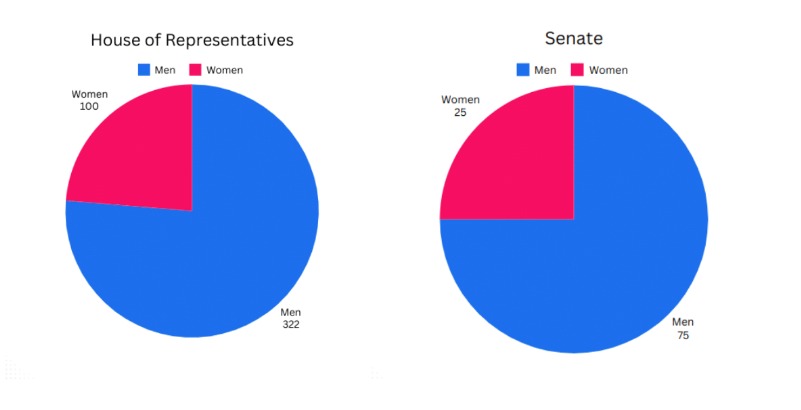
Women in the U.S. were only given the right to vote in 1920, with the passage of the 19th Amendment to the U.S. Constitution. The last country in the world to provide women the right to vote was Saudi Arabia in 2011. Saudi Arabia’s King Abdullah will also allow women to run in local elections and serve on his national advisory council, although the king appoints all 150 members to the council (Epatko 2011). The women’s suffrage movement gained momentum in countries globally after WWI and WWII, primarily due to women entering industrial jobs, which spurred economic and social change for women (Zinko 2007). Surprisingly, Switzerland did not allow women to vote until 1971, which is amazing considering it was one of the wealthiest democratic countries in the 20th century.
Earlier in this module, we referenced that in 2021, the U.S. was ranked 30th in the Gender Gap Index. Before 2012, the U.S. was ranked 17th but slipped five places to 22nd in 2012, primarily due to a smaller percentage of women in political decision-making positions (Cann 2012).
Is the decrease due to fewer women being interested in politics than men, or are there structural barriers? Historically, there have been barriers to keep women from entering politics, which may contribute to a lack of interest. A more plausible explanation is that barriers still exist, making it more difficult for women to enter politics. Once elected, women may experience harsh criticism, as in the case of the “Squad” in 2019. This progressive group of four U.S. Representatives, Alexandria Ocasio-Cortez (D-NY); Rep. Ayanna Pressley (D-MA); Rep. Ilhan Omar (D-MN); and Rep. Rashida Tlaib (D-MI), have even received death threats.
Women in politics are underrepresented in the U.S. and the majority of countries around the world. Although women make up half of the U.S. population, they only make up 27 percent of the U.S. Congress. Globally, women hold only 23.4 percent of the seats in parliaments. Rwanda leads the world with approximately 61 percent female members in Parliament, followed by Cuba with 53 percent. Rwanda uses electoral gender quotas as a fast track to gender balance in politics (The World Bank 2022). Electoral gender quotas set specific numbers of seats for women in the elected governmental body. These quotas for women do not discriminate but are designed to compensate for barriers preventing women from their fair share of the political seats. Do you think electoral gender quotas could gain traction in the U.S.? Within the U.S. Congress?
Gender Stratification in Education and the Military
Education is a social structure that has a tremendous influence on developing and reinforcing gender norms and roles of children, adolescents, and college students. Beginning in kindergarten and elementary school, the process of socialization shapes children’s views of differences between the sexes in areas such as status and power. In many ways, schools indoctrinate and perpetuate the patriarchal system, but this process is slowly changing.
Education
Twenty years ago, it was common to read how girls were disadvantaged and boys were privileged in school settings (Sadker, Sadker, and Zittleman 2009; McCormick 1995; Sadker and Sadker 1994; Bailey 1992). Today, many historical disadvantages attributed to girls and women in education have disappeared and reversed in some cases. More females are enrolled in college, their degree completion rate is higher, and they represent nearly three-fifths of all graduate students. This trend is depicted in Table 9.2.1 and is called the “feminization” of higher education (French 2017; U.S. Department of Education 2017; Leathwood and Read 2009).
Many students begin paying back student loans after graduation. The debt burden is greater for women since their income is approximately 20 percent less than men (in 10 years, women make 31 percent less than men). Fifty-three percent of women graduates struggled with student loan debt compared to 39 percent of men. In both cases, they paid more of their earnings toward student loan debt than a typical worker could reasonably afford to pay (Dugas 2012; The American Association of University Women 2012). Despite these structural barriers, there are individual and structural means of closing the gender wage gap using education as a catalyst.
For women, the quickest means of closing the gender wage gap is to major in accounting to pursue a career as a bookkeeper, accountant, or auditing clerk. In these three occupations, women earn the same wage as men after graduation (Sanders 2015; Dugas 2012). Women can also close the gap by choosing higher-paying majors, such as medicine, computer science, math, science, and engineering. However, the gender socialization process in elementary and secondary schools does not encourage girls to pursue these professions. Changing gender stereotypes about women’s capabilities in science, technology, engineering, and mathematics (STEM) must continue to be a priority in the educational system. Exposure of students to STEM fields beginning in elementary school, and the provision of scholarships and inducements to choose STEM careers, are both means to increase the number of female engineers and scientists (Rotherham 2011). Other ways of closing the gender wage gap will likely result naturally as more women earn degrees than men. As discussed next, similar structural barriers in the military limit women from high-ranking positions that pay higher salaries.
The Military
The U.S. military is a male-dominated institution with many restrictions on women’s participation. In 1976, the U.S. Congress authorized women for admission to all services academies. In 2021, 29 percent of the U.S. Naval Academy’s enrollment of 1,186 undergraduate students were females (USNA News Center 2021). A recent decision to allow female cadets to wear ponytails and braids was made to make the Navy more inclusive (Philipps 2021). The two most controversial and publicized issues during the last two decades have been whether women should be admitted to all-male military colleges and academies and whether women should engage in combat. The first issue has played itself out legally in the Supreme Court, and the second has been settled by the military, allowing women to enter all combat positions (Howell 2016; Kruse 2016; CNN 2014).
In 1993, Shannon Faulkner was admitted to the Citadel, an all-male elite military college in South Carolina. Since the Citadel did not enroll women, she was unknowingly admitted, based upon the assumption she was a male. When administrators learned she was a female, she was denied admittance. The Faulkner family appealed, and the U.S. Supreme Court heard the case in 1995. The ruling was that if the Citadel continued receiving public funds, then the military college could not deny admission based on sex, as an all-male admission policy was unconstitutional. Faulkner was allowed to enroll and was escorted onto campus by U.S. Marshals on August 15, 1995. She had security cameras in her dorm room and wore a panic button around her neck. She left after a week, stating she was subjected to psychological and emotional abuse and experienced severe dehydration. As she left the campus, the male cadets celebrated (Chang, Sintay, and Clarke 2009). Much has changed since her entry and exit. In 2021, 858 females and 2,835 males were enrolled at the Citadel (Citadel 2021). Faulkner is now a middle school teacher in South Carolina and is proud of her achievement of gaining entrance for females into previously all-male military colleges. Nearly two decades after her court victory, another legal battle was instrumental in gaining entrance for women into combat zones.
The most often cited reasons to exclude women from direct combat are that women’s physical abilities are less than men’s (the claim that a woman cannot carry an injured male out of a battle zone), the inclusion of women will hamper mission effectiveness by hurting morale and cohesion, and fear of women being abused by enemies (Horn 2010; Sisters in Arms 2009). Baldwin and Haring argued that women had been discriminated against by not being able to serve in combat, and the policy was unconstitutional. Specifically, the lawsuit claimed that by excluding women from direct combat based solely on sex, the policy unfairly restricted women from career advancement opportunities and higher earnings and pensions. In 2013, the military lifted the ban allowing women to serve on the frontlines and special combat roles, including elite forces such as Army Rangers and Navy SEALs (Londono 2013; ABC News 2012).
Before the lawsuit, the U.S. Defense Department had already been examining the issue by opening up thousands of jobs for women closer to the front lines. One new policy “attached” women to combat troops, allowing them to serve in support roles but not engage in combat. Neither of these policies provided the same monetary benefits as men receive who serve in combat. To some degree, society had a voice in this issue as the military decision-makers listened to the public. A 2012 national poll of registered voters indicated 75 percent were in favor of women who serve in the military and who want to serve in ground units that engage in close combat should be allowed to do so — only 22 percent opposed, indicating public support of voluntary service by women in combat zones. Four years later, the public policy came into step with public sentiment. In March 2016, Defense Secretary Ashton Carter approved the final plans to allow women in all combat positions immediately (Howell 2016; Kruse 2016). In the next module, we will focus on other social problems related to sex and gender.
Problems Experienced by Women around the World
When a family perceives that a daughter has done something to bring shame to the family, some cultures believe that the only way to rectify the situation and restore honor to the family is to kill her. Known as honor killing, the killing of a female family member for the perceived shame she has brought onto the family, this type of violence against women is often assumed to only occur in the Middle East or Muslim culture. As you can see by hovering your mouse over the images below, honor killings occur worldwide and are not bound by one particular society.
Honor killings have occurred around the world, and the perpetrators are not always Muslim — they occur across different cultures. In many cultures, women are expected to honor their culture and family’s expectations over their individual wishes. The Turkish women in the photo are protesting and denouncing honor killings.
The actions that may result in a family deciding to kill their daughter include anything from smoking a cigarette in public to losing her virginity before marriage, speaking to a member of the opposite sex, becoming too Westernized, or even driving a car.
North Texas teens Amina and Sarah Said were killed by their father, Yaser Said, in 2008 in what the FBI identified as an honor killing. According to relatives, the father’s motive for killing his daughters is that, allegedly, they were dating boys of whom he disapproved. After being on the FBI’s most wanted list for over 10 years, Yaser was caught in 2020 and sentenced to life in prison in 2022.
While historically, girls and women are the only victims of honor killings, in 2012, Nevin Yildirim, a 26-year-old Turkish woman who reportedly had been the victim of repeated rape by a family member, killed and beheaded her rapist in a bid to restore her own honor. She was charged with murder and is serving a life sentence (Hurtas 2015).
Sadly, also in 2012, Saudi cleric, Fayhan al-Ghamdi, tortured and killed his five-year-old daughter because he believed she was no longer a virgin. His punishment? Initially, only four months in jail and a $50,000 payment to the girl’s mother. But under international pressure, his punishment was increased to eight years in prison and 800 lashes.
While those opposed to honor killings have become more vocal, this is just one type of violence experienced by women and girls worldwide. Continue reading to learn more about the range of issues experienced by women in the 21st century.
Violence against Women
Between December 2012 and January 2013, two shocking incidents on opposite sides of the world remind us of the dangers women still face in the 21st century. The first case occurred in Delhi on December 16, 2012, when a 23-year-old medical student and her male companion headed home after seeing a movie. They boarded what they mistakenly thought was a public bus with only six people on board, the driver and his five male friends. The men attacked the couple, beating the male companion unconscious and gang-raping and beating the woman. She died days later as a result of the massive injuries she sustained. Protests erupted across India, and the six men, including a minor, were charged with murder
Less than a month later, details of an attack in August 2012 in Steubenville, Ohio, came to light. At a high school party that involved alcohol, an unconscious 16-year-old girl was raped by two high school football players, dragged around the party, and reportedly urinated on. All of this occurred in front of other students who tweeted about the rape, took videos, and posted pictures on Instagram. According to accounts, the 16-year-old victim and her family became aware of the incident after seeing images of her assault online. The football players were arrested and charged with rape, but questions were raised about the culpability of others attending the party and whether the Steubenville police were showing favoritism toward the players. In late January 2013, while the defendants were under house arrest awaiting trial, an online petition of 70,000 signatures was delivered to the state’s Attorney General demanding further investigation into the case. In March of 2013, the two football players, Trent Mays, 17, and Ma’lik Richmond, 16, were found guilty of rape and sentenced to youth prison (Dean 2013; Dissell 2013; Johanek 2013; Muskal 2013; Macur and Schweber 2012).
Although these cases took place on opposite sides of the globe, what unites them not only with each other but millions of others is that both incidents involved violence against women, any act that results in the mental, physical and/or sexual harm of a girl, teen, or woman (HP). The types of violence that women experience often vary depending on where they live but include rape and domestic violence perpetrated by family and/or an intimate partner, genital mutilation, and acid burning, just to name a few.
Social Learning Theory
Definition: Individuals who witness or experience violence while growing up are likelier to use violence as adults.
Explantation: A little boy who witnesses his father beat his mother may see the behavior as normal and grow up to be abusive toward his partner.
Social Situation or Stress Theory
Violence is greatly influenced by the stress in a particular situation that may be part of the larger society or specific to a particular group. Also, culture may work to normalize violence in society.
Whether caused by an individual’s job loss or a nationwide recession, financial problems in a family act as a stressor that may increase the likelihood of violence against women. Cultural norms that promote violence include violent movies and video games.
Resource Theory
One perspective on this theory states that the more resources an individual has, the more control and force he can apply in the relationship. On the other hand, some contend that the fewer resources a person has, the more likely he is to compensate by resorting to violence.
A person who controls the family finances and makes all the decisions has greater resources at his command than one who shares responsibilities with his spouse. By contrast, a suddenly unemployed person may resort to violence towards his partner to compensate for his lack of income and perceived loss of power.
Exchange Theory
Based on the economic principles of costs and benefits, this theory contends that an abuser will use violence when the benefits exceed the costs.
An abuser knows slapping his partner means that she will do as he demands and will not call the police on him, therefore costing him nothing
.Feminist Theory
Looks at the history of male domination in societies worldwide and contends that larger social and economic processes work to subordinate women in society and the home.
Paying women less money than men, not valuing their work in the home, and not having laws to protect women in the event of violence puts them in a lesser position in society and the home.
General Systems Theory
The violence experienced by women isn’t just about the individual abuser but about the family systems or structure overall, which is made up of multiple people that play varying roles that are changeable over time.
An abusive husband injured on the job and can’t work may find his position in the family system changed when his formerly dependent wife becomes the family breadwinner.
From Resource Theory to General Systems Theory, possible explanations for violence abound, but theories cannot actually stop the violence. What is known for sure is that the violence women experience is not just about the act itself but also power and control issues. Designed in the 1980s, based on the experience of women in Duluth, Minnesota, the Power and Control Wheel in Figure 9.3.1 has been translated into over 40 languages and distributed to women around the world, and provides an overview of the different types of abuse used to exert power and control over women. Figure 9.3.1 applies the wheel to individuals in abusive relationships.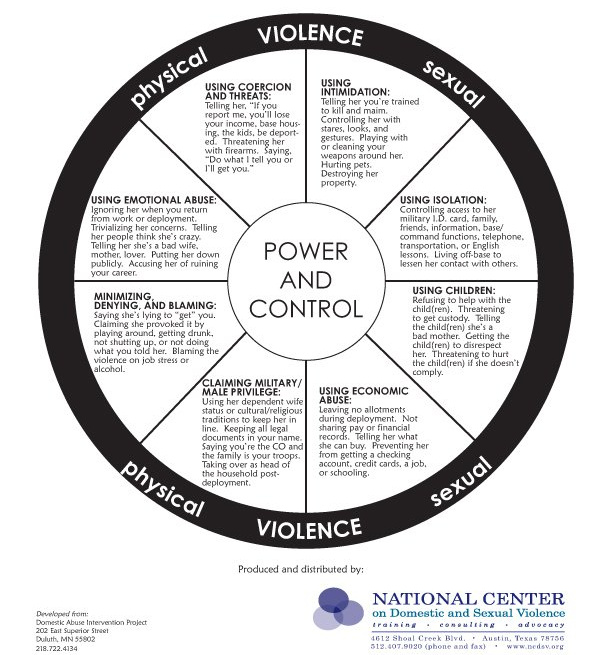
- Making them afraid by using looks, actions, and/or gestures
- Smashing things
- Destroying their property
- Abusing pets
- Displaying weapons
- Putting them down
- Making them feel bad about themselves
- Calling them names
- Making them think they’re crazy
- Making them feel guilty
- Controlling what they do, who they see and talk to, what they read, and where they go
- Limiting their outside involvement
- Using jealousy to justify actions
- Making light of the abuse and not taking their concerns about it seriously
- Saying the abuse didn’t happen
- Shifting responsibility for abusive behavior
- Saying they caused it
- Making them feel guilty about the children
- Using the children to relay messages
- Using visitation to harass them
- Threatening to take the children away
- Treating them like a servant
- Making all the big decisions
- Acting as the master of the castle
- Being the one to define the relationship roles
- Preventing them from getting or keeping a job
- Making them ask for money
- Giving them an allowance
- Taking their money
- Not letting them know about or have access to the family income
- Making and/or carrying out threats to do something to hurt them
- Threatening to leave them, commit suicide, or report them to welfare
- Making them drop charges
- Making them do illegal things
The Power and Control Wheel seemingly is designed to depict how abusers wield power and control in relationships
Men can be victims of violence.
This is true.
Estimates are that one in three women and one in four men are the victims of abuse at the hands of an intimate partner. Approximately 1.6 million men in the U.S. are victims of rape at some point in their lifetime. Each year approximately 5 percent of men are killed by their current spouse, former spouse, or intimate partner (National Coalition Against Domestic Violence [NCADV] 2017; 2015).
Violence against women (C-19) and men is a social problem worldwide, reinforced by cultural and structural factors related to power and control. Patriarchal culture is one of the biggest barriers to reducing violence against women in many countries. Improving educational opportunities for women will gradually combat cultural messages that men are superior to women and should assert their dominance. Understanding how social structures and institutions perpetuate power and control in societies is the beginning of reducing violence in relationships. With these understandings in mind, many actions can be implemented to lower the prevalence of violence, as we will discuss in the next learning objective.
Action for Women
A 2009 Harvard University study found a link between women’s status and treatment in society and society’s overall peacefulness. Interestingly, the correlation between women and peacefulness is greater than the relationship between peacefulness and democracy (Maffly 2009). Specifically, researchers found that the better the women are treated in a country, the higher the rates of financial prosperity, the greater people’s health, the greater the trust in government, and the lower levels of government corruption (Future’s Without Violence 2009; Maffly 2009; Hudson et al. 2008/9). It is worth noting that a variety of international and national governing bodies have taken steps toward reducing and, ideally, eliminating the incidence of abuse and death women experience at others’ hands. The United Nations has symbolically identified November 25 as International Day to Eliminate Violence Against Women to encourage groups and organizations worldwide to bring attention to the problem in their communities (United Nations 2017). More concretely, since its inception in 1996, the United Nations Trust Fund has provided monies to over 463 programs in 139 countries to help eradicate violence against women (United Nations Women 2017).
Attempts to eradicate violence in a specific society generally involve implementing legislation to increase the penalty for actions taken against women in society. In the U.S., one piece of legislation that received much attention in 2013 was the Violence Against Women Act (VAWA). VAWA legislation contained a few key provisions designed to improve society’s response to violence against women:
- requiring that orders of protection be honored throughout the nation
- mandating that rape victims not have to pay for the cost of their rape exam and creating rape shield laws that prevent a woman’s past sexual conduct from being used against her in court
- increasing training for law enforcement officials and members of the criminal justice system regarding the realities of violence against women
- distributing grant money to many of the nation’s programs to prevent violence against women
(White House 2013)
The Violence Against Women Act was signed into law in 1994. The first major evaluation of its effectiveness reported that the number of violent incidents experienced by women at their partners’ hands was reduced by 67 percent, and the number of homicides declined by 35 percent (White House 2013).
In 2022, President Biden signed the reauthorized VAWA legislation (The White House 2022). Through the years, the political climate has made it difficult for the Democratic and Republican Congress members to agree on aspects of the legislation, such as whether non-tribe members who abuse Native American women, undocumented immigrant women, or gay and lesbian victims of violence should be included in the legislation (Serwer 2013). Figure 9.3.2 is an example of how VAWA used statistics in a campaign to bolster support for the act’s reauthorization.
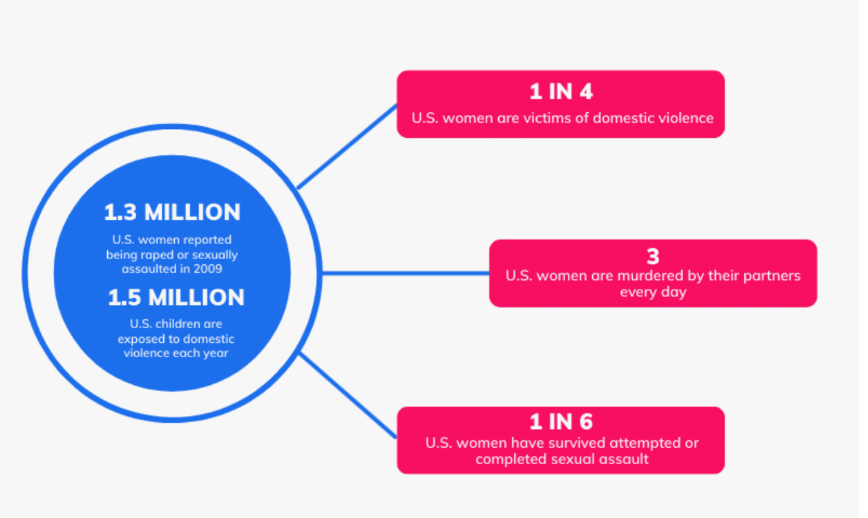
It is worth noting that during the period in which the Violence Against Women Act was under negotiation, the law provisions were not eliminated, and no one was given a free pass to abuse women. Eventually, it was agreed that Native American women, immigrant women, and gay and lesbian victims should all be covered by the act.
Functionalist Theory: Regarding social problems associated with sex and gender, the functionalist perspective examines policy’s intended and unintended consequences and how such policies contribute to society.
How has the Violence Against Women Act contributed to the overall stability of American society? Can you identify any ways in which it might have been detrimental to society?
Conflict Theory: The conflict perspective perceives the social problems associated with sex and gender as a power struggle between dominant and subordinate groups. The powerful, dominant group institutes policy that members of the less powerful subordinate group find objectionable.
Do current policies on violence against women only favor the dominant group? What policies should be developed to support the needs and concerns of both women and men in society?
Symbolic Interactionism: Symbolic interaction contends that people view social problems through the lens of their own life experiences. When it comes to issues of violence, the process of socialization and interaction with others serves to reinforce or dispel the behavior.
Can policies around the issue of violence and abuse be developed to help improve relationships between men and women in society?